Smart Schedule for Faxes: How Timing and Retries Work
Table of Contents
It's 5 p.m. in Chicago and the signed contract is ready to go. You hit send, and it arrives in Tokyo at 7 a.m., either in a tray nobody will touch for two hours or on a machine that's been powered down since Friday. The document went out. The handoff didn't start.
Ready To Fax?
Start sending faxes online in seconds with FaxZen - No account required
Send Fax Now 🚀What a Smart Schedule Does for Your Fax
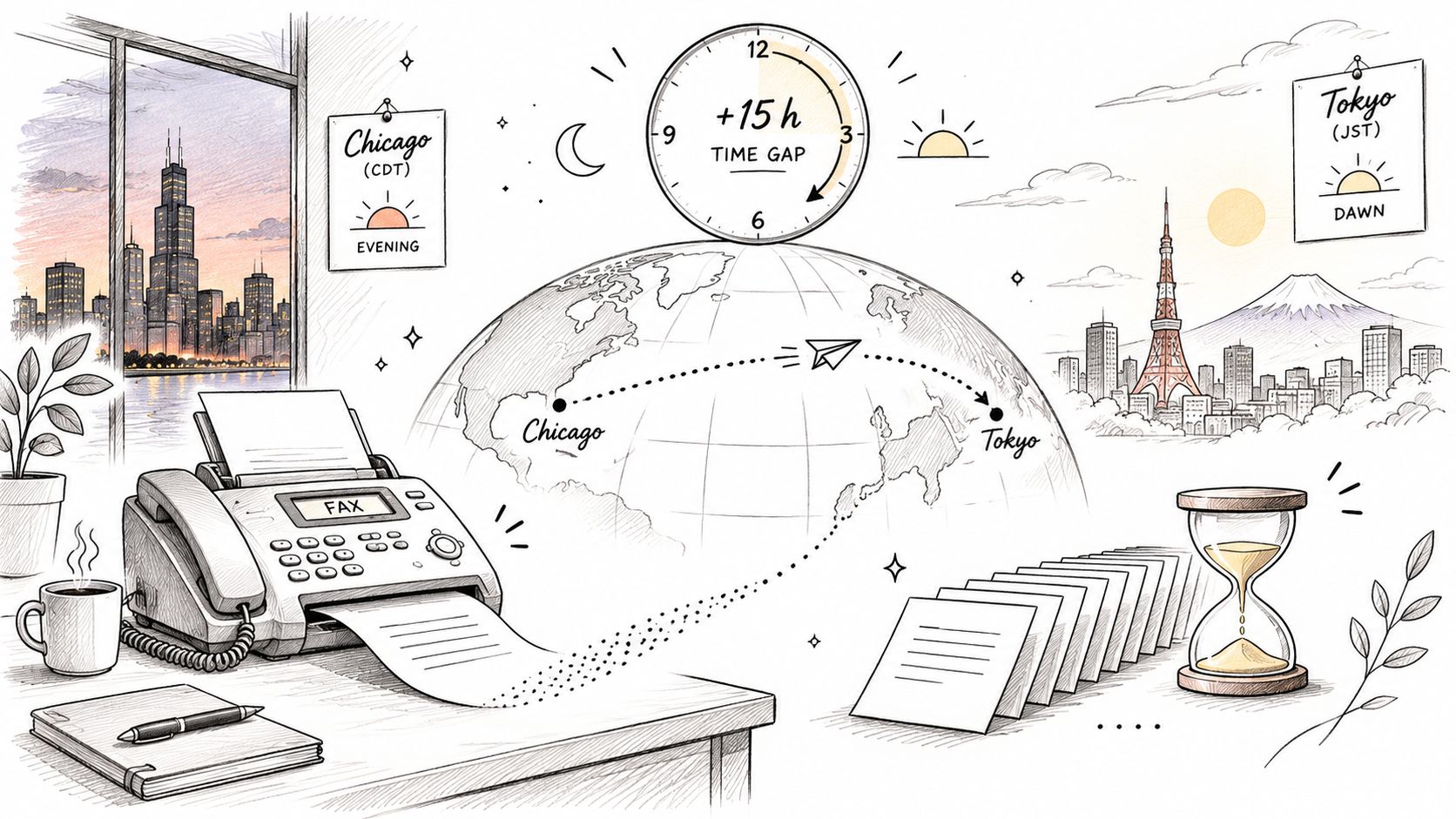
A smart schedule holds a fax in a queue and releases it when the recipient's office is likely to be staffed, not when you happen to be at your desk. It's the difference between booking dinner for the hours the restaurant serves and booking it for the hours you got hungry.
You can pick the day and hour yourself at FaxZen and let the scheduler work out what that hour means on the other end.
Three mechanisms carry the job. Time zone detection turns a local delivery window into one exact moment in UTC. Business-hour delivery steers the fax into the recipient's working day. Retry logic resends temporary failures on a schedule that doesn't just repeat the same mistake. Here's how each one works, where it pays off, and how to set one for a filing you can't miss.
How Time Zone Detection Picks the Delivery Hour
A zone stored as "EST" is wrong for most of the year. Store the recipient's location as a named time zone instead, so the offset can be resolved for the specific delivery date. NIST's daylight saving time explainer sets the U.S. rule: clocks move forward at 2:00 a.m. on the second Sunday in March and back at 2:00 a.m. on the first Sunday in November, with Eastern Standard Time at UTC−5 and Eastern Daylight Time at UTC−4, while most of Arizona stays on Mountain Standard Time year-round.
| Location | Standard offset | Daylight-saving offset | Switch rule |
|---|---|---|---|
| New York | UTC-5 (EST) | UTC-4 (EDT) | Second Sunday in March to first Sunday in November |
| London | UTC+0 (GMT) | UTC+1 (BST) | Last Sunday in March to last Sunday in October |
| Tokyo | UTC+9 (JST) | None | No daylight saving time |
| Sydney | UTC+10 (AEST) | UTC+11 (AEDT) | First Sunday in October to first Sunday in April |
| Phoenix | UTC-7 (MST) | None | Stays on Mountain Standard Time year-round |
A fixed offset breaks the moment the clocks move. A fax set for 9:00 a.m. New York lands at 8:00 or 10:00 local after a switch, while a rule-based scheduler holds 9:00 a.m. Two edge cases need an explicit decision: the skipped spring hour moves forward to the next valid instant, and the repeated autumn hour takes the earlier occurrence.
Practical rule: Store the zone, not the offset. An "EST" record is wrong for roughly eight months of the year.
Find the row by the recipient's city, not their country, since a single country can span several offsets. If you're sending from the U.S. to a number abroad, the guide to sending an international fax from the USA covers the numbering format too.
Retry Logic for Busy Lines and Failed Sends
A busy signal is temporary, and the scheduler should treat it that way without confusing it for a fault. T8, defined in the ITU-T T.30 standard, is the timeout for waiting while the receiving terminal is busy; the same T.30 recommendation specifies short timers such as T6 at 5 ± 0.5 seconds and notes that a command repeated three times without a response signals a protocol problem. Those timers bound a single call. They say nothing about when a service should try again.
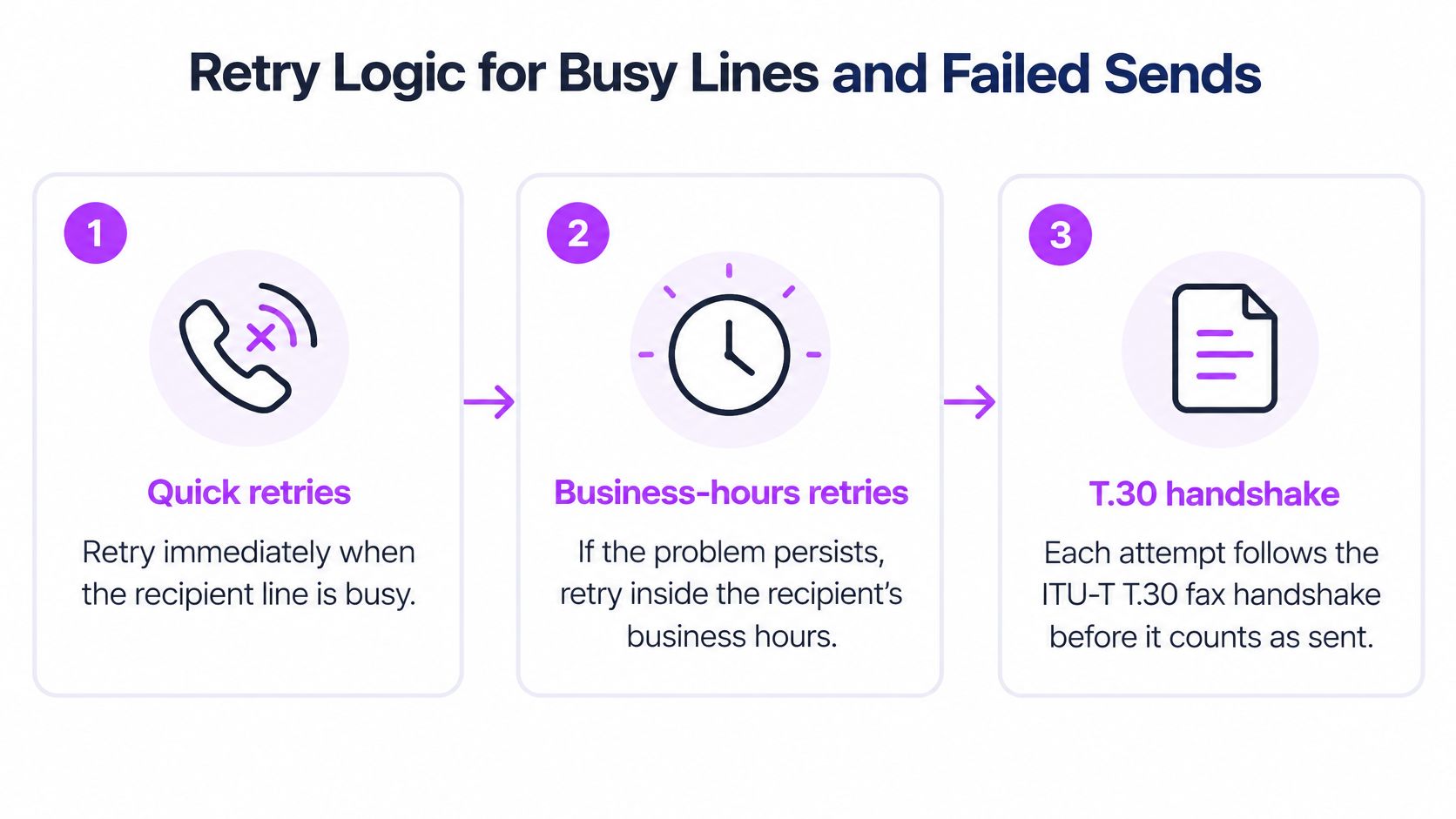
The sequence that works:
- Attempt the fax.
- Classify the result.
- Stop on permanent failures.
- Back off with jitter for temporary ones.
- Hold non-urgent retries until the next business window.
- Record every attempt with its time, outcome and next scheduled try.
| Failure | Retried | Timing rule |
|---|---|---|
| Busy line | Yes | Quick retries with jittered backoff, then business-hours retries |
| No answer | Yes | Next retry inside the recipient's business window |
| Protocol timeout | Yes | Backoff before the next session; cap repeated exchanges |
| Invalid fax number | No | Stop immediately and report the failure to the sender |
T.30 timers govern one call session. The scheduler governs when the next session starts.
The final status should list each attempt, its outcome, and whether the deadline is still reachable. When attempts keep failing, the fax troubleshooting guide explains how to read the error.
Benefits and Use Cases Across Industries
Queuing a fax changes the risk profile of a handoff, and the gain shows up in specific pairings of sender and recipient.
A law firm serving counsel abroad schedules for 9 a.m. in the recipient's city, so the pages land while a clerk is at the machine. An individual returning a tax form to an overseas revenue office picks a morning slot and skips the arithmetic. A jury duty reply to a county office two zones away no longer gets worked out at 11 p.m. The same logic serves a bank sending account forms to a branch, or a clinic sending a referral during the specialist's intake hours. For regulated records, our guide to secure handling covers the retention side.
One case where queuing hurts: a filing that must leave now. If someone is waiting on the line or the deadline has already started running, send immediately. The test is whether a few hours' delay changes the outcome. If it does, don't queue it.
Scheduling a Fax Before a Deadline
Sort the document before you schedule it. A routine document can wait for the recipient's business hours and tolerates next-business-day delivery. A deadline-bound filing should target business hours too, but start early enough to cover connection setup, page transmission, busy-line retries and confirmation. A clinically urgent record needs the recipient's after-hours intake policy confirmed first; if it's urgent, send it now and confirm receipt.
The Federal Register notice on faxed pleadings shows why completion time matters: a pleading counts as filed on a business day when the complete transmission is received by 12:00 a.m. A first attempt at 11:59 p.m. leaves no room for one retry, and the transmission has to finish, not merely start.
| Fax type | Scheduling approach | Margin before cutoff |
|---|---|---|
| Routine document | Queue for the recipient's business hours | Next business day is acceptable |
| Deadline-bound filing | Target business hours and retry inside that window | Start early and allow 2-4 hours for retries |
| Clinically urgent record | Check the after-hours intake policy, then decide | Send immediately if urgent and confirm receipt |
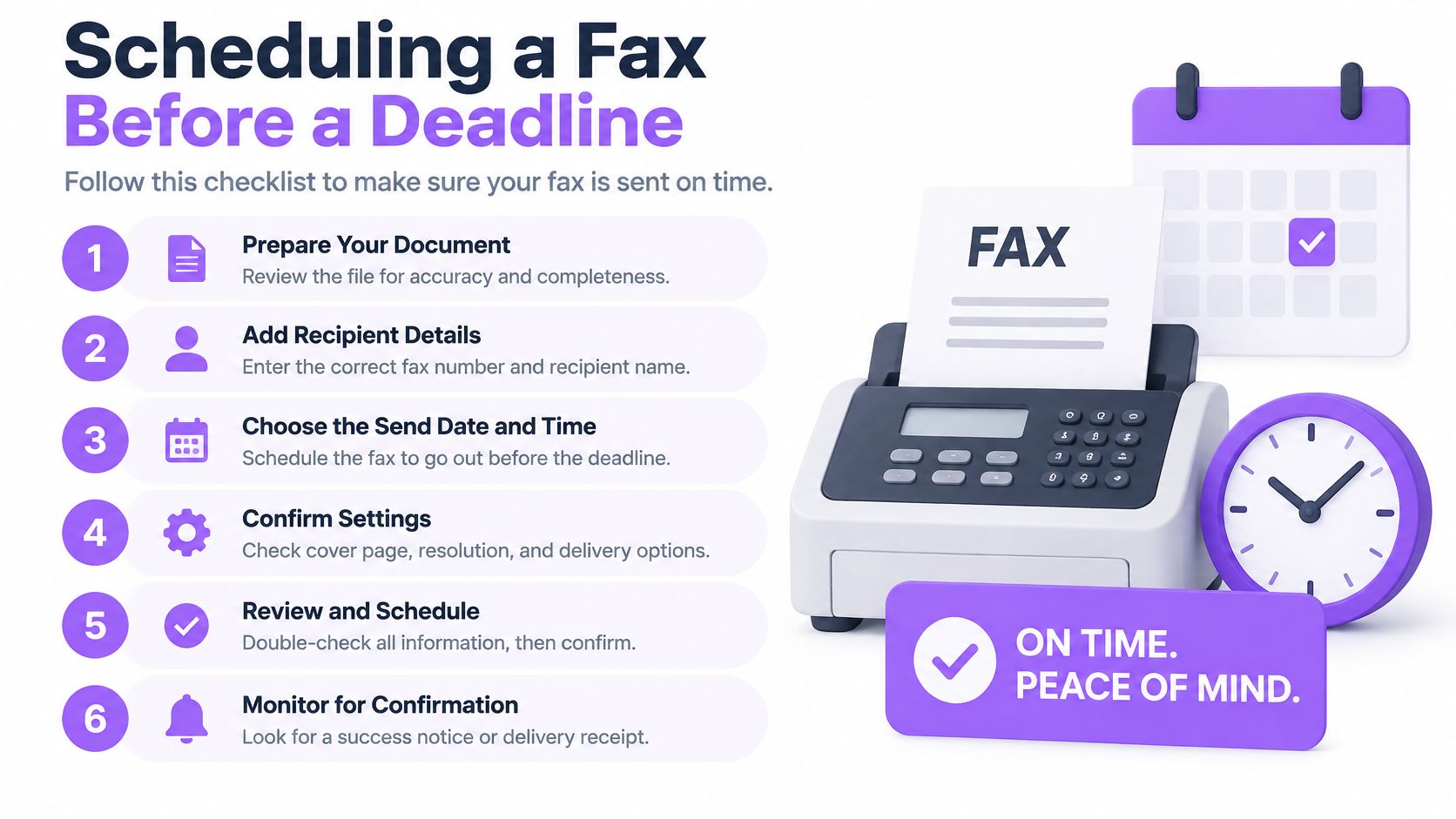
The checklist: confirm the recipient's zone and its daylight-saving rule; classify the fax; set the window inside their business hours; add margin before any cutoff; save the proof. If the document is a tax filing, check how to fax documents to the IRS first, because the receiving office's own hours matter more than yours.
A successful transmission is not a review. Confirm by phone when someone has to act on the pages.
FaxZen's scheduler suggests delivery times from the detected time zone, tracks a fax from preparation to delivery with local-time conversion, and emails a confirmation with the original document attached once delivery succeeds. For the mechanics of a deadline, this walkthrough is worth four minutes:
The best schedule matches the recipient's working day and still leaves room for the retries the fax may need.
Smart Schedule Questions Answered
Can I schedule a fax for a weekend or holiday? Yes, but not blindly. The scheduler can aim at the recipient's weekday hours; it can't always know local holidays, so check the public holiday calendar for their country and region.
What if the line stays busy all day? Retries keep running until the window closes, then the final status shows the failure, and you can resend or call the recipient.
Does this work for international numbers? It works when the recipient's time zone is known, so confirm country and region before you schedule.
Does a delivery confirmation mean someone read it? No. It confirms transmission. A fax confirmation sheet proves the pages arrived, not that a person opened them.
Related Articles
- Sending an international fax from the USA: numbering formats and dialing prefixes for the destinations in the offset table above.
- Fax troubleshooting: how to read the error behind a failed attempt instead of resending blindly.
- Secure handling for regulated records: retention and handling rules for clinics, banks and law offices.
- How to fax documents to the IRS: the tax-filing case, including which hours and margins to plan around.
- Reading a fax confirmation sheet: what the timestamps prove and what they leave out.
FaxZen lets you pick the delivery date up to 30 days out, detects the recipient's time zone, and suggests a time that falls inside their working day. Every send comes back with real-time status tracking and an email confirmation carrying the original document, so you have a record of when the pages landed. Visit FaxZen to schedule your next fax and stop guessing at the other end's clock.