Fax Confirmation Sheet: What It Is and Why You Need One
Table of Contents
You've sent an important document, watched the fax complete, and then received a message asking when it was delivered. Without a reliable record, a simple deadline question can become a dispute.
Ready To Fax?
Start sending faxes online in seconds with FaxZen - No account required
Send Fax Now 🚀For a practical way to send documents and retain delivery evidence, visit FaxZen. The service provides online faxing and confirmation records without requiring a physical fax machine.
The Problem - When You Need Proof You Sent It
A contract deadline has passed. A government office says it never received your filing. A client disputes whether a signed document arrived. In each case, remembering that you pressed “send” isn't enough. You need a contemporaneous record showing what number was dialed, when the transmission occurred, and what the fax system reported.
A fax confirmation sheet provides that paper trail. It records a specific transmission event, which is why legal professionals and regulated industries have kept confirmation pages with their original documents for decades. Courts have often treated these records as strong evidence that a fax reached the intended machine, while still allowing the other party to challenge that conclusion if non-receipt can be shown. Legal guidance on fax confirmations explains this distinction clearly.
Keep the confirmation with the source document, especially for tax submissions, contracts, and filings. If you're preparing a signed PDF before faxing it, you can also sign a PDF in your browser before creating the transmission record. For sensitive submissions, review this guide to sending tax documents securely.
What Is a Fax Confirmation Sheet
A fax confirmation sheet is a transmission record, not just a receipt. It usually identifies the destination fax number, the sender or originating number, the date and time of the session, the number of pages, and the final status.
Those fields create an auditable timeline. The number confirms where the system attempted delivery. The timestamp places the event in relation to a filing deadline. The page count helps you check whether the complete document was transmitted, while the status indicates whether the receiving fax infrastructure accepted the pages.
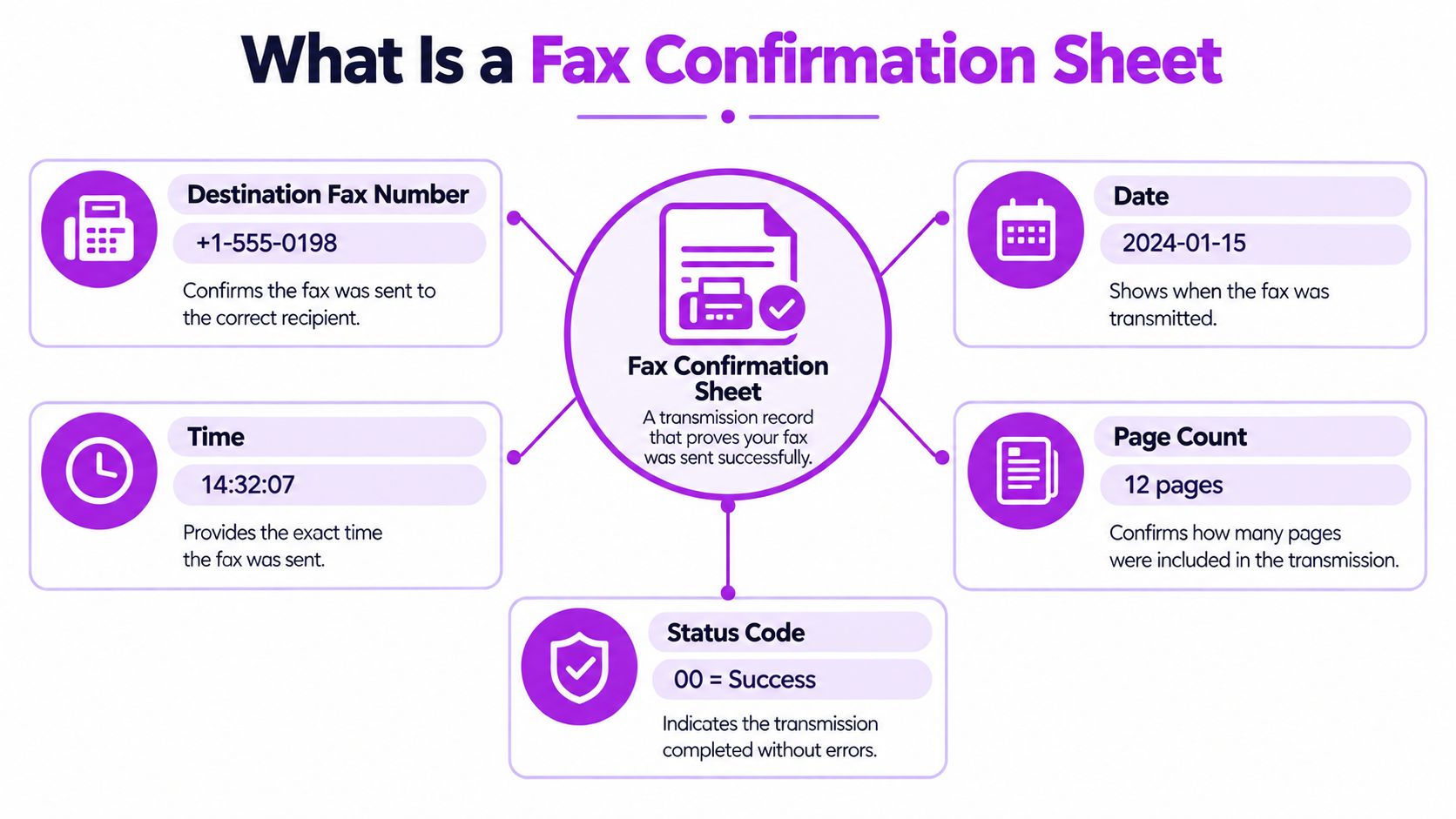
The important limitation is easy to miss. A successful confirmation supports attempted or completed transmission to a machine, but it doesn't prove that a person read the document, routed it internally, or found every page legible. For related terminology, see this explanation of what a fax header is.
Reading the Confirmation - Status Codes and Fields
Start with the status. A successful result generally means the receiving fax infrastructure accepted the transmission. A busy result means the destination line wasn't available, while an error indicates that the session failed and needs investigation.
Connection duration and page count add useful context. A page count that doesn't match your original document deserves attention, even if the status says successful. Digital reports can also preserve these fields as machine-readable, timestamped data, which makes them easier to search and include in an audit trail. Fax audit trail guidance describes why these details matter operationally.
| Status Code | Meaning | Action Required |
|---|---|---|
| Successful | The receiving fax infrastructure accepted the transmission | Save the report with the original document |
| Busy | The recipient line was occupied or unavailable | Verify the number and retry |
| Error | The transmission did not complete normally | Review the error detail, then verify the number or connection |
Core distinction: A confirmation is evidence of transmission to a receiving machine, not proof of human receipt or review.
For a fuller explanation of the fields and outcomes, consult this guide to a fax transmission report.
From Paper to Digital - How Fax Confirmations Changed
Fax confirmations became practical because machines adopted built-in transmission logs. By the late twentieth century, most fax machines could print or store records of sent and received transmissions, including the time, date, and fax numbers involved. That change turned a telephone-based communication into an auditable business process. Historical legal guidance on fax records documents this role.
Today, online services preserve the same core function electronically. Instead of a paper strip, you may receive an email or downloadable report with status, page count, connection details, and the original document attached. Digital records are easier to search, copy into a document-management system, and retain with related correspondence. The format changed, but the central value remains the same, a timestamped record of a transmission event. Learn more about fax in the cloud.
Why Fax Confirmations Matter for Your Business
A confirmation can carry real evidentiary weight. In some United States legal contexts, it may support a rebuttable presumption of receipt, meaning the record is persuasive unless the other side provides evidence to challenge it. A 2025 Fifth Circuit case treated a successful fax confirmation sent to the correct recipient as probative evidence that an FTCA presentment requirement had been satisfied. The court's decision shows how a transmission record can matter in an actual dispute.
That makes confirmations useful for contract service, legal filings, and deadline-sensitive submissions. They're stronger when paired with the document itself and the surrounding transmission logs.

Recordkeeping rule: Preserve the confirmation alongside the original payload and timestamped logs. The confirmation doesn't prove that the contents were correct or that a person read them.
Recordkeeping and Security Best Practices
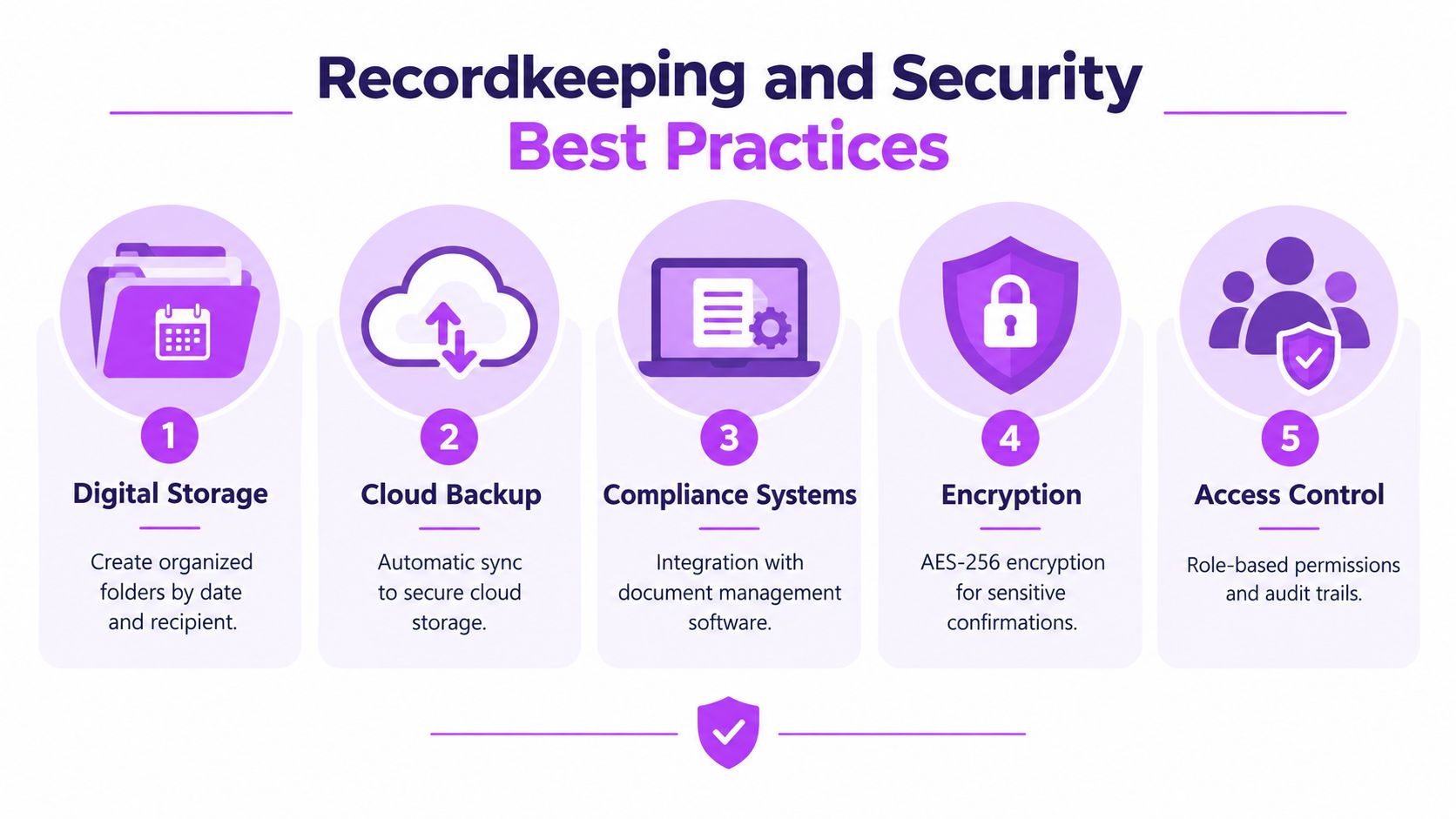
Create a consistent archive as soon as a transmission finishes. Store the original document and confirmation together in an organized digital folder, named by date, recipient, and subject. Back up the files to an approved cloud location, and restrict access to staff who need the records for their work.
A confirmation's practical value comes from concrete fields such as the sender number, recipient number, timestamp, page count, and success or failure status. This explanation of fax transmission records shows why those details help during disputes. FaxZen supports downloadable confirmation records, while its stated security features include 256-bit SSL encryption, automatic document deletion after 24 hours, and secure Stripe payments.
For teams handling many files, TOOLii's clinical document tools may help organize related records. Also define a retention process with guidance on document retention policies.
- Save the payload: Keep the exact document that was sent.
- Save the report: Retain the confirmation in the same record.
- Check failed attempts: Record retries and any corrected recipient details.
- Limit access: Use permissions and audit trails where available.
Related Articles
- How to send tax documents securely
- What is a fax header
- Understanding a fax transmission report
- Fax in the cloud
- Document retention policies
FAQ
Does a fax confirmation sheet prove delivery
It generally supports delivery to the receiving fax infrastructure at a recorded time. It doesn't prove that a human received, read, or correctly routed the document.
What should I do if the status says error
Check the destination number and the detailed error message first. Common causes include a busy line, poor line quality, incompatible modem speeds, or VoIP packet loss and jitter. Retry after correcting the likely cause rather than assuming that a failed report is proof of delivery.
Are fax cover sheets legally required
A cover sheet isn't generally required by federal law for standard fax transmissions. It's still common practice and should identify the recipient, sender, phone number, fax number, date, and total pages. A subject line and confidentiality notice may also be appropriate for sensitive material.
FaxZen lets you upload a PDF or image, enter the recipient's fax number, and receive real-time status updates and email confirmation records. Visit FaxZen to send your next time-sensitive document and keep a downloadable transmission record with your files.