Fax HIPAA Compliance: A Practical Guide for 2026
Table of Contents
- The Six Safeguards Every Fax Process Needs
- Why Faxing Patient Data Is Allowed but Easy to Get Wrong
- Verify, Send and Record Every Fax
- Vendor Agreements and Audit Logs
- Breach Deadlines and What to Do After a Misdirected Fax
- Provider and User Checklist Before Go-Live
- Common Questions About Faxing Patient Information
- Related Guides for Your Fax Setup
A misdial is rarely dramatic. Someone reads a number off an old consult note, the machine dials, and the pages print in a stranger's tray. The sender files the confirmation slip as proof nothing went wrong.
Ready To Fax?
Start sending faxes online in seconds with FaxZen - No account required
Send Fax Now 🚀Federal health privacy rules don't forbid faxing patient records. They ask for safeguards that match the risk, and they judge the entire process rather than one setting. If you're replacing a machine with an online service, FaxZen is one option to weigh against the checklist below.
The Six Safeguards Every Fax Process Needs
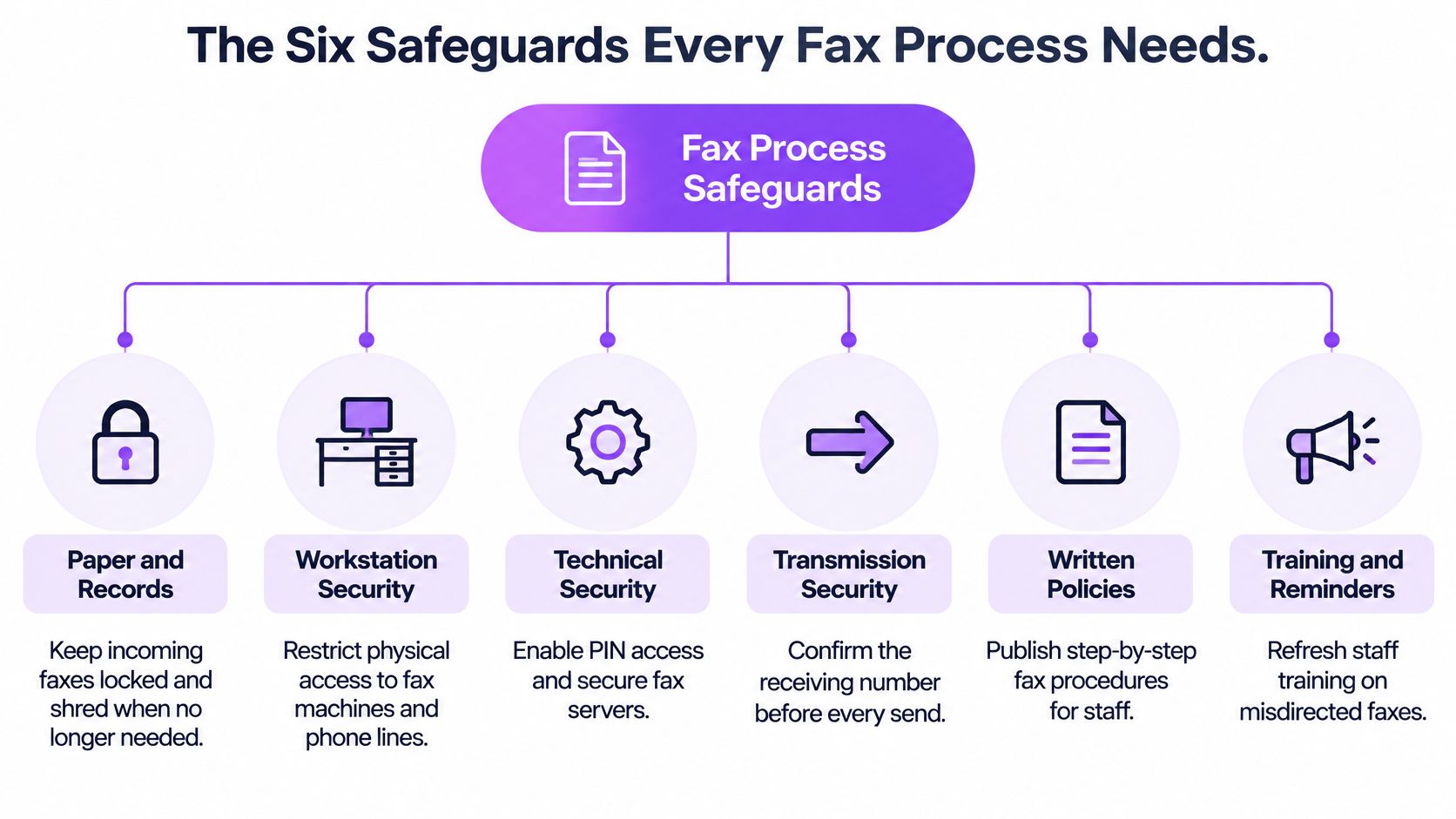
| Safeguard | What It Requires | Fax Example |
|---|---|---|
| Recipient verification | Confirm the destination number before every send | Check the lab's fax number against a saved, confirmed contact |
| Access control | Limit who can send, view and download | Only billing staff can open the fax inbox |
| Transmission protection | Protect data in transit and at rest | Use encrypted upload and delivery |
| Audit controls | Record who sent what and when | Exportable log with timestamps |
| Retention and deletion | Set how long copies are kept and when they are removed | Automatic deletion on a defined schedule |
| Incident response | Document steps for misdirected or failed faxes | Written escalation path to the privacy lead |
Two rows carry more weight than the rest. Recipient verification and access control stop the disclosure before it happens; encryption, logs and deletion limits only shrink the damage afterward. Fix the cheap items first, because a saved contact list and a locked inbox cost nothing.
Virtual clinics meet the same problem in a different medium, and patient privacy in online psychiatry shows how a telehealth practice handles recipient checks and record access. Encryption deserves its own scrutiny too: what document encryption actually protects covers where it helps and where it stops.
Why Faxing Patient Data Is Allowed but Easy to Get Wrong
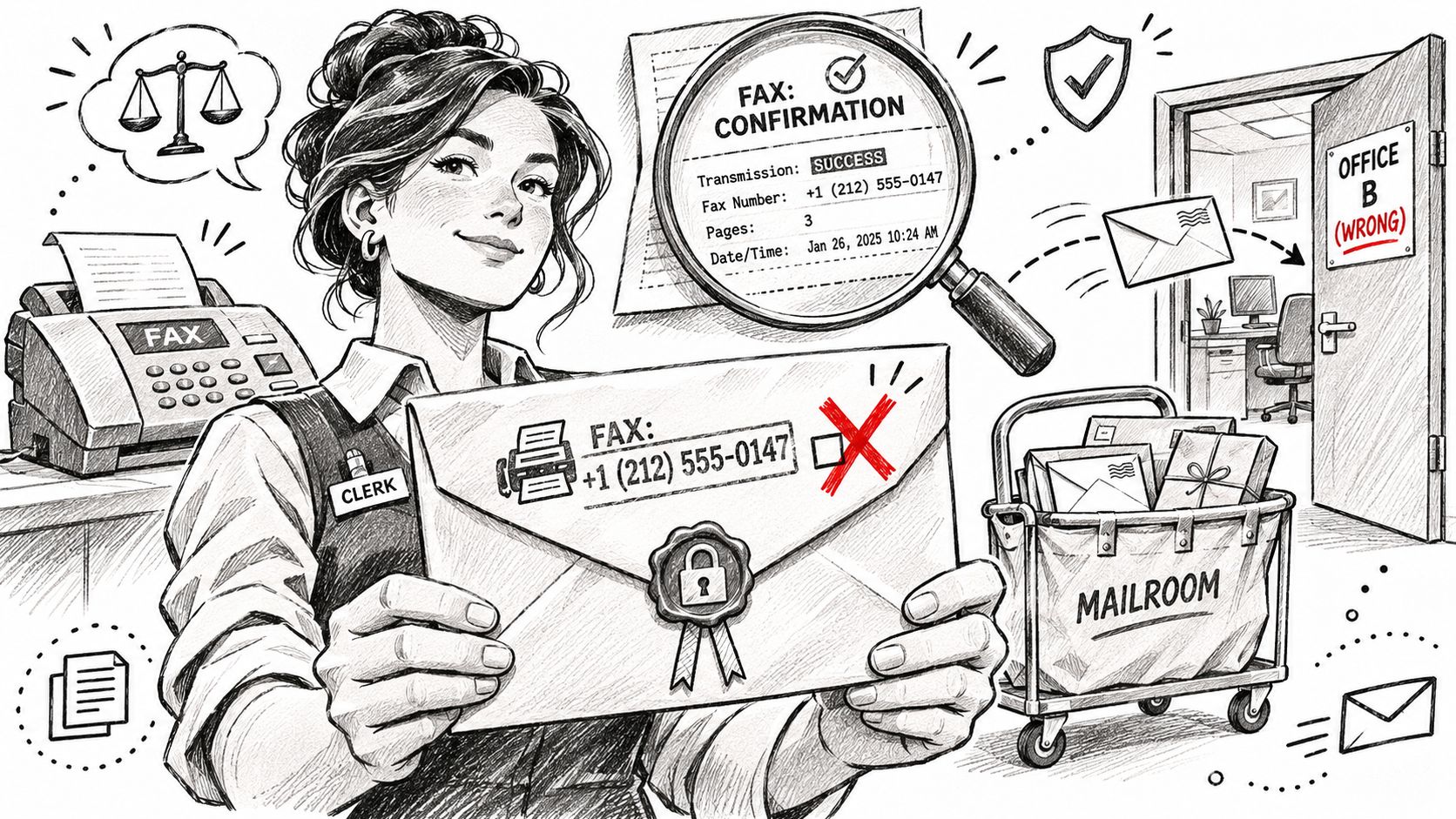
Think of a fax as a sealed envelope with an address nobody verified. Mailing it is lawful. The harm comes from a wrong address or a mailroom that leaves the envelope open on a desk.
The U.S. Department of Health and Human Services FAQ on faxing names two practical steps: confirm the destination number is correct, and keep receiving equipment where unauthorized people can't see incoming pages. It also treats a clean transmission report as proof of delivery, not proof of safe handling. You still have to assess physical, administrative and technical controls and train the people who press send.
The split matters. Privacy rules reach paper and electronic records alike; security rules apply once the information exists electronically, at the sender, in transit or in the recipient's inbox. That's why the rest of this guide focuses on people and steps, since the technology rarely fails on its own. Teams comparing tools can read healthcare privacy rules explained for the wider framework.
Verify, Send and Record Every Fax
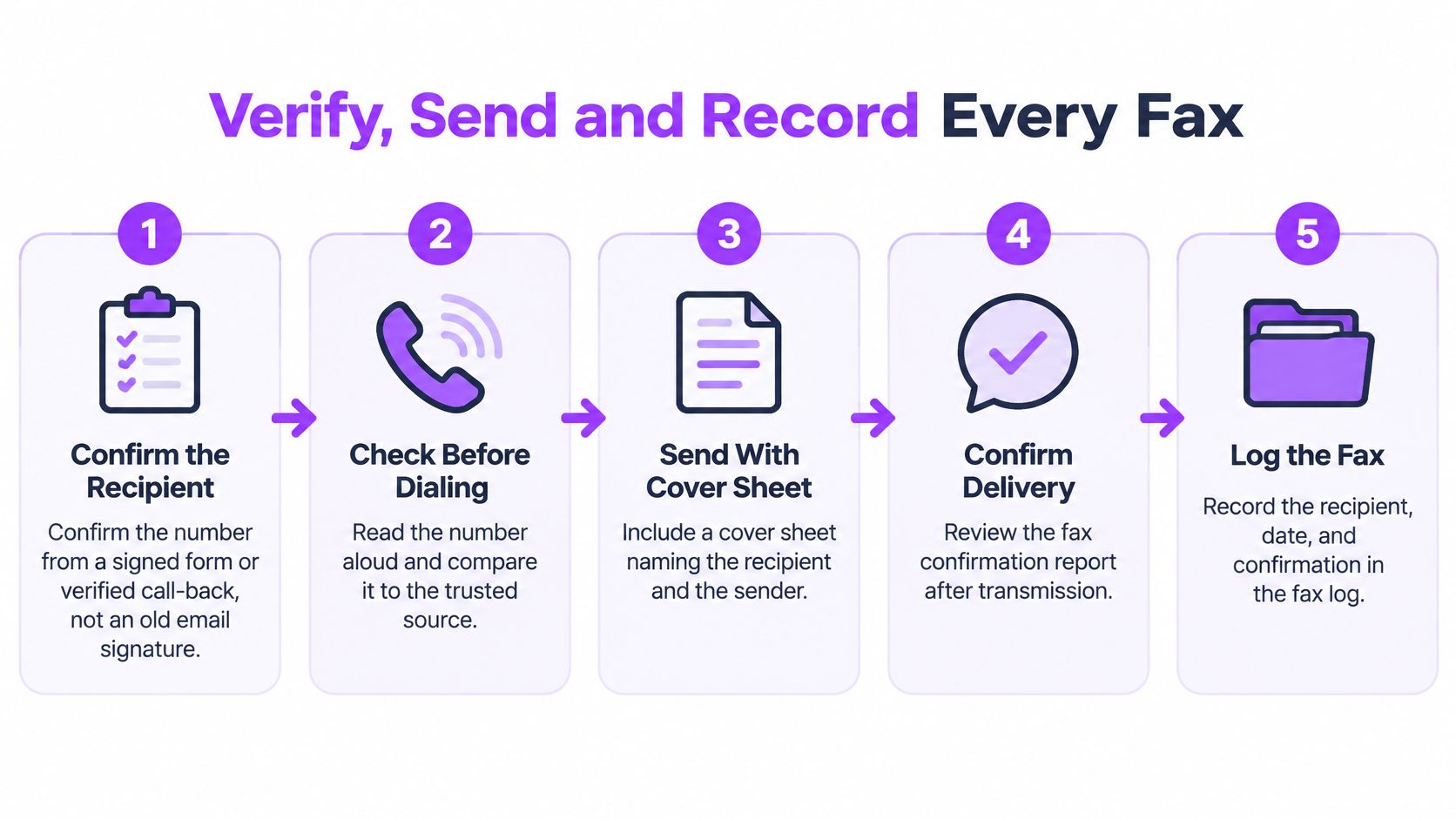
- Confirm the number from a trusted source. A signed form, a verified call-back or the recipient's own published listing. Never an old email signature.
- Save recurring recipients. Staff pick a controlled contact instead of retyping digits.
- Match the name to the request. Compare the organization on the document with the one you're dialing.
- Trim to the minimum. Send the pages the purpose needs.
- Attach a cover sheet. Recipient, sender, page count and a request to destroy misdirected pages.
- Check the receiving end. Confirm the machine or inbox sits in a restricted area.
- Record the outcome. Delivery status, time and any failure, before you close the task.
| Common Mistake | Typical Consequence | Fix |
|---|---|---|
| Typing a number from memory | Fax reaches a stranger | Verify against a saved, confirmed contact |
| Sending without a cover sheet | Pages arrive with no sender identity or instructions | Attach a cover sheet listing recipient, sender and page count |
| Unattended receiving machine or inbox | Staff who should not see patient pages can view them | Restrict the area and limit inbox access to named staff |
| Duplicate submissions | Extra copies create retention gaps | Log each send and check its status before resending |
| No confirmation for urgent faxes | Delays go unnoticed | Confirm delivery and escalate any unconfirmed time-sensitive fax |
Fax still carries a lot of clinical traffic: in 2025 more than a third of documents sent to healthcare facilities were faxes, 52% of surveyed organizations processed incoming faxes by hand, and 88% of practitioners said fax-related delays hurt patient care, according to Medical Economics.
Pre-send gate: number verified, pages trimmed, cover sheet attached, receiving area restricted, delivery record saved. That's under a minute of work.
A confirmed transmission never proves the intended person opened or processed the file. Escalate and log every time-sensitive fax that goes unconfirmed, and check that the number you dialed is the one on file with how to verify a fax number.
Vendor Agreements and Audit Logs
Any service that stores or forwards your pages on your behalf is a business associate, and that holds even when the provider can't read the traffic. The HHS Security Rule guidance makes the consequence clear: encryption is an addressable safeguard, so you assess the risk, apply it where appropriate, and document your reasoning when you don't. Integrity, availability, contingency planning and a written risk analysis sit alongside it.
Ask prospective vendors in writing whether they sign a business associate agreement, whether every user gets a unique login, whether logs can be exported, what retention and deletion controls exist, how incidents get reported, and whether a risk analysis exists. A security badge answers none of those questions. On our side, documents you send stay yours, we hold a limited licence to process and transmit them, and nothing is shared with third parties beyond what the transmission requires.
A log you can't read isn't evidence, so check what a fax transmission report records before you rely on one.
Breach Deadlines and What to Do After a Misdirected Fax
| Obligation | Deadline | Applies To |
|---|---|---|
| Individual breach notice | Without unreasonable delay, no later than 60 calendar days after discovery | Each affected person |
| Federal report, 500 or more people | Without unreasonable delay, no later than 60 calendar days after discovery | Covered organization |
| Federal report, fewer than 500 people | Annually | Covered organization |
| Security documentation retention | Six years from creation or last effective date, whichever is later | Policies, risk analyses and incident records |
Individual notices should describe what happened, the types of information involved, steps people can take to protect themselves, the investigation and mitigation, and a contact. The HHS breach notification rules set that 60-day outer limit and the annual route for smaller incidents.
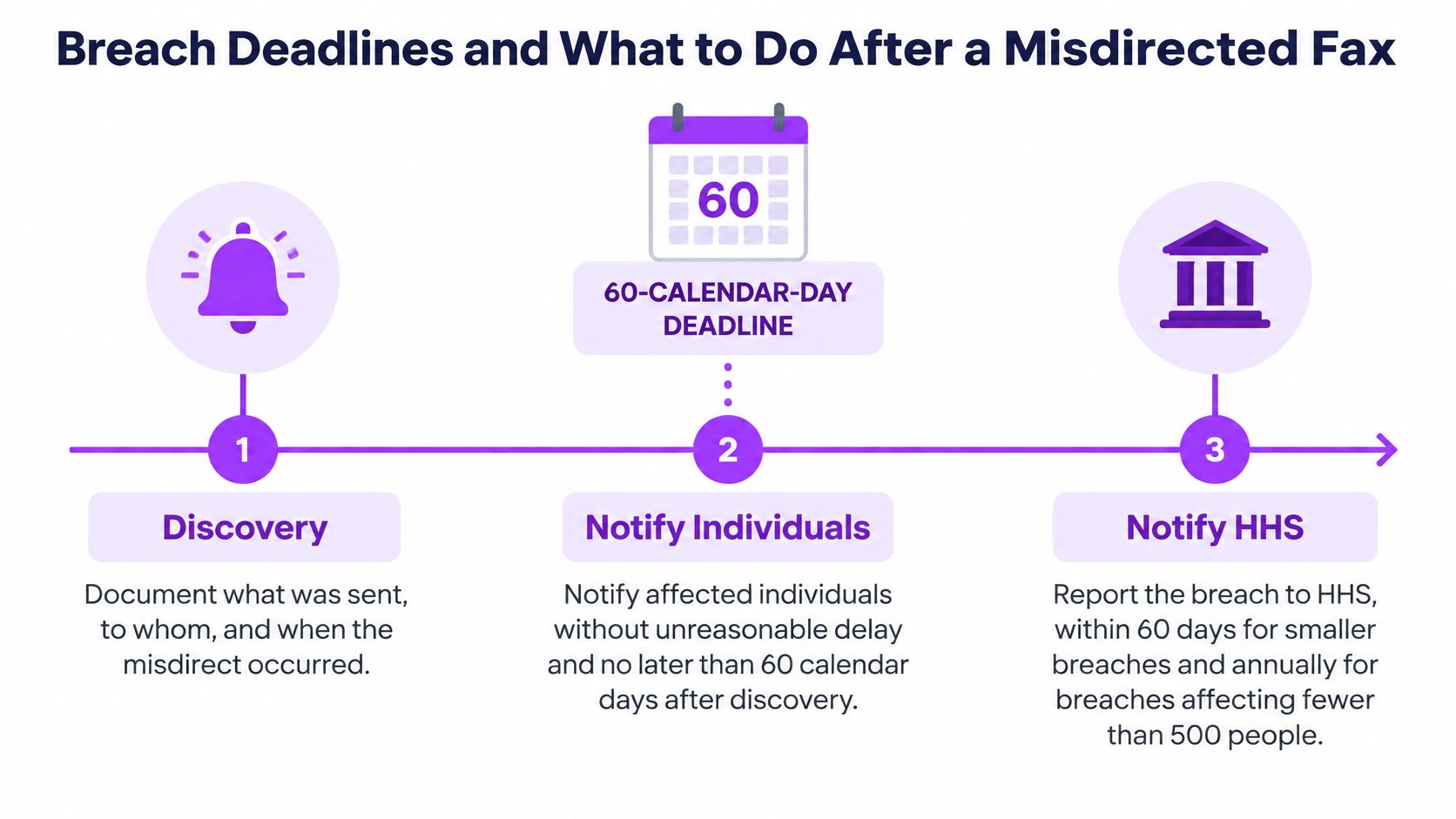
Your delivery records do the investigative work. We track each fax through four stages on a status page and send real-time updates plus an email confirmation when delivery succeeds, so you hold a dated file showing the recipient number, the outcome and the moment you learned of the problem. Start the clock on the day of discovery, not the send date, and write that discovery time down. For how reporting duties look in another records-heavy field, Texas Autopsy Services on record privacy is a useful parallel read.
Provider and User Checklist Before Go-Live
Split the checks by owner. The provider owes you a signed business associate agreement, unique user IDs, exportable audit logs, a documented risk analysis, an incident reporting procedure and deletion controls. Your organization owes a named privacy lead, a written fax policy, a restricted receiving area, a verified contact list and a training record for everyone who touches patient pages.
File the evidence for each item: the signed agreement, a sample log export, the policy version number, the training sign-off. Request everything in writing before the first patient fax, then schedule a documented review ninety days after go-live so the records stay current. A cover sheet that names recipient, sender and page count belongs in that policy, and the fax cover sheet guide shows what to put on it.
A policy nobody can produce on request is a hope, not a control.
Common Questions About Faxing Patient Information
Can a small practice manage this without a dedicated privacy officer? Yes, provided one named person owns the duties, the policy is written down and the review is documented. Today, name that person in the policy.
Can a consumer fax app carry patient records? The controls decide suitability, not the brand or the price: business associate agreement, unique logins, exportable logs, deletion limits. Today, request those four items in writing.
Is a fax machine in a shared break room a problem? The test is whether unauthorized people can see incoming pages. Today, move the device or the inbox to a restricted area.
Should staff email a PDF instead of faxing? Email has its own risks and its own safeguards, and the choice depends on what the recipient can accept. Today, confirm the recipient's preferred channel.
Related Guides for Your Fax Setup
Three walkthroughs cover the sending side once the process is settled. The PC fax guide suits occasional senders who work from a browser. Sending from a phone with a cover sheet and a checked recipient is covered in the iPhone fax guide. Mac users can build the same verification steps into routine documents with the Mac fax guide.
Review the service itself at FaxZen, and keep the safeguards above in place whichever tool you choose.
FaxZen lets you send patient pages, contracts and filings from a browser without a machine, with encrypted transmission, a status page, real-time updates and an email confirmation once delivery succeeds. Documents are automatically deleted from our servers after 24 hours, and you keep ownership of everything you send. Visit FaxZen to upload a PDF, enter the recipient's number and get a dated delivery record for your file.