Online Fax Service Free: What You Actually Get
Table of Contents
- What “Free” Actually Means in Online Faxing
- The Common Free Models and How They Work
- The Real Cost of Free Compared to Pay-Per-Fax
- Security Claims That Don't Tell the Full Story
- When a “Successful” Fax Still Fails You
- Why Pay-Per-Fax Often Beats Both Free and Subscriptions
- How to Choose Any Online Fax Service Wisely
- Frequently Asked Questions About Free Online Fax
The popular advice about a free online fax service starts with the wrong question. “How many pages can I send without paying?” matters less than “Can I prove the recipient's fax endpoint received the document?” A green upload screen won't defend a contract, tax filing, or medical record if it only confirms that a file reached the platform.
Ready To Fax?
Start sending faxes online in seconds with FaxZen - No account required
Send Fax Now 🚀Fax still matters in healthcare and administration. A Medical Group Management Association poll found that 89% of healthcare leaders reported fax use in 2019, while the Council for Affordable Quality Healthcare estimated that 51% of commercial-market prior-authorization transactions still used manual processes such as phone calls or fax. Free can be useful, but only when the record it creates is useful too.
If you need a one-time send with clear status tracking, send a fax online with FaxZen, without buying a machine or opening a long-term subscription.
What “Free” Actually Means in Online Faxing
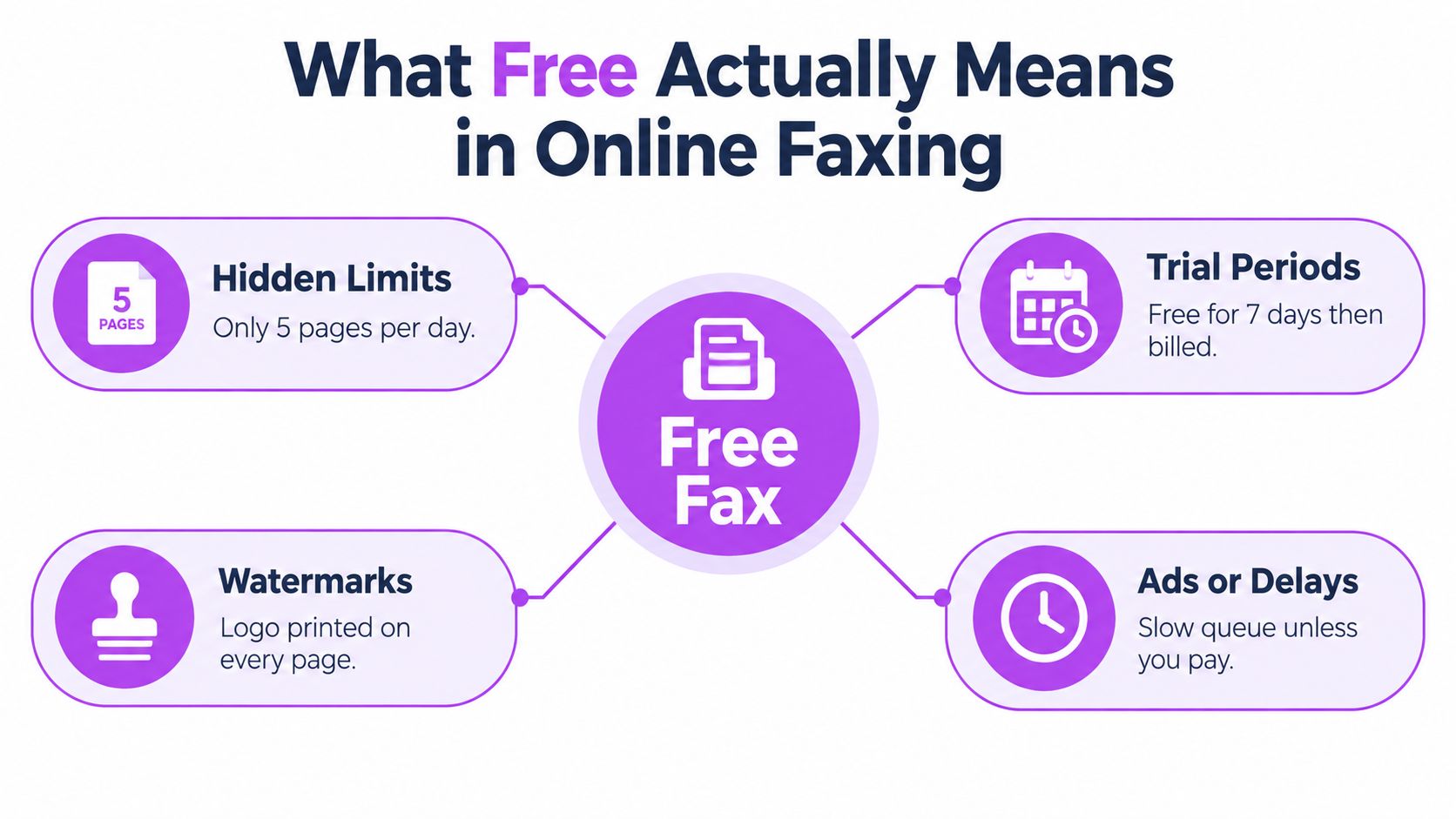
“Free” usually describes the price at the first click, not the complete workflow. A service may offer a short trial, a small page allowance, advertising, or a mobile-only path. Each model shifts a cost somewhere else, often into time, privacy, account requirements, or weak delivery evidence.
The first check is simple. Ask what happens after the first send, after the trial ends, and after a transmission fails. A page cap may be harmless for a casual note but useless when a contract has attachments. A watermark can make a filing look unprofessional. An ad-supported service may place commercial material on the cover page or expose the sender to a slower queue.
Practical rule: Treat delivery evidence as the product. The free page is only the entry point.
A browser-based service can still solve a real access problem. Fax technology has moved from hardware to software over decades, including computer-based faxing in 1985 and internet fax products in 1996, as documented in this history of fax technology. Read more about the practical distinction in faxing online for free, but don't confuse no payment with no risk.
The Common Free Models and How They Work
Free offers tend to follow a few repeatable patterns. None is automatically dishonest. They're designed around customer acquisition rather than the sender's audit file.
A trial model gives you access for a limited period, then asks for payment or converts into a subscription. The danger isn't the trial itself. It's forgetting what happens to uploaded documents, stored fax history, and billing details when the trial closes.
A capped model limits pages or sends. It works for a short note and breaks down when you have a multi-page filing or a second urgent transmission. An ad-supported model funds the service through advertising, which may mean branded cover pages, promotional interruptions, or delays before the platform accepts the send.
An app-only model creates a different failure point. You may have a document on a desktop, shared drive, or legal case folder, but the free workflow expects a phone photo or mobile upload. That adds handling steps and can create avoidable quality problems.
| Free Model | How It Actually Works | Hidden Cost |
|---|---|---|
| Trial access | Full or partial features are available temporarily | Subscription conversion and unclear retention |
| Page cap | Sending stops after a small allowance | A deadline arrives after the allowance is gone |
| Advertising | Ads fund the free transmission | Branding, delays, or less control over the workflow |
| Mobile-only | Sending happens through an app or mobile browser | Desktop documents need extra handling |
Before choosing an app, compare its upload path with your actual work in the guide to free fax apps. A tool that accepts a PDF but doesn't provide a useful final receipt isn't complete for a legal or administrative workflow.
The Real Cost of Free Compared to Pay-Per-Fax
The cost of a fax isn't limited to the amount charged at checkout. It includes account setup, document handling, waiting, troubleshooting, and the consequences of missing evidence. For an occasional sender, a pay-per-fax workflow can be cheaper operationally even when the free option has no visible fee.
| Operational question | Free tier | Pay-per-fax workflow |
|---|---|---|
| Account required | Often | May allow one-time sending |
| Document retention | Must be checked carefully | Clear deletion terms matter more than account features |
| Delivery record | Varies widely | Should include destination, time, result, and transmitted document |
| Advertising exposure | Possible | Usually absent |
| Failed transmission | May require another attempt | Retry behavior should be documented |
The mistake is treating every confirmation as equivalent. A platform can confirm that it accepted an upload while the receiving fax line is busy, incorrect, unavailable, or unable to complete the transmission. The Federal Trade Commission's online fax privacy assessment illustrates why retention deserves direct questions. Portal data may exist only through transmission and confirmation, while email-relay copies can remain under mailbox rules and transmission logs may be retained for up to a year.
A modest sending fee is predictable. An unprovable deadline submission isn't.
For occasional users, the sensible comparison is not free versus subscription. It's one-time cost versus recurring exposure. If you fax only when a bank, insurer, court, or tax office demands it, a monthly inbox full of old attachments may create more administration than it removes. Pay for the send when the workflow needs a dependable record, and choose free only when the document and consequence are low-risk.
Security Claims That Don't Tell the Full Story
“256-bit SSL” sounds reassuring, but it answers only part of the security question. Transport encryption protects data while it moves between your browser and the service. It doesn't explain who can access the file after upload, how long the file remains stored, whether logs contain sensitive metadata, or whether deletion is immediate and verifiable.
NIST identifies TLS 1.3 as the preferred current protocol and describes how it removes older constructions such as RSA key transport, static Diffie-Hellman exchange, CBC cipher suites, and SHA-1 in its TLS guidance. Ask the provider which TLS version it negotiates, whether files are encrypted at rest, and how access is logged.
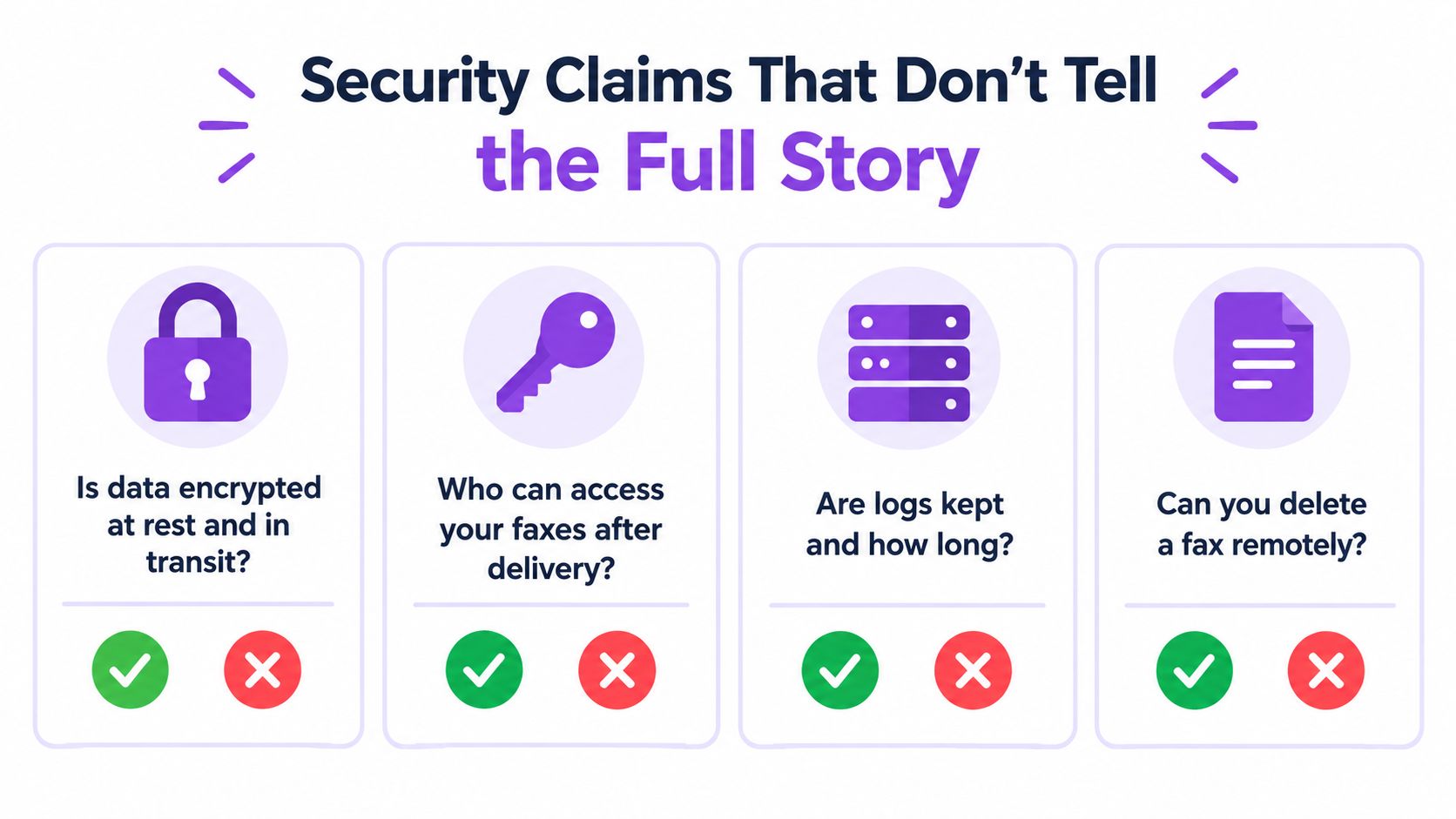
Questions that expose weak controls
Check retention for the original upload, failed sends, email confirmations, and transmission logs. A service should also explain whether staff can access stored documents and whether users can remove them without contacting support.
For sensitive records, recipient controls matter as much as encryption. The U.S. Department of Health and Human Services permits treatment-related information sharing by fax when reasonable safeguards are used, including confirming an unfamiliar recipient number and controlling access to the receiving device. That guidance appears in its fax and patient information FAQ.
Read whether fax is more secure than email, but don't reduce the decision to one transport label. Security is a chain. A strong connection followed by indefinite storage and broad access is still a weak document workflow.
When a “Successful” Fax Still Fails You
An attorney sends a contract to opposing counsel. The platform displays “successful,” so the attorney saves a screenshot and closes the browser. Later, the recipient says nothing arrived. The screenshot proves that the sender interacted with a service. It may not prove that the receiving fax endpoint completed the transmission.
The same problem affects a tax filer sending a deadline document or a clinic forwarding a record to an insurer. A file can be accepted, queued, partially transmitted, rejected, or sent to the wrong number. Those states have different consequences, but cheap services often collapse them into one reassuring message.

What a defensible receipt should show
ITU-T Recommendation T.30 defines a Message Confirmation signal, or MCF, for a satisfactorily received message. It also describes PPR responses, which identify image frames that need retransmission, in the T.30 recommendation.
That technical detail matters because “uploaded” and “delivered” are different events. A useful record should identify:
- Destination: The fax number that received the attempt.
- Timing: The transmission date and time.
- Final result: Completed, failed, busy, or another clear status.
- Confirmation evidence: A receipt or code tied to the actual transmission.
Ask one blunt question before sending: Does this receipt prove transmission to the recipient's device, or only acceptance by the sending platform? The answer belongs in your decision, alongside the fax transmission report guidance.
Why Pay-Per-Fax Often Beats Both Free and Subscriptions
Pay-per-fax is the practical middle ground for people who send occasionally but can't afford vague records. It avoids the recurring commitment of a subscription while giving the provider a reason to make the individual transaction clear.
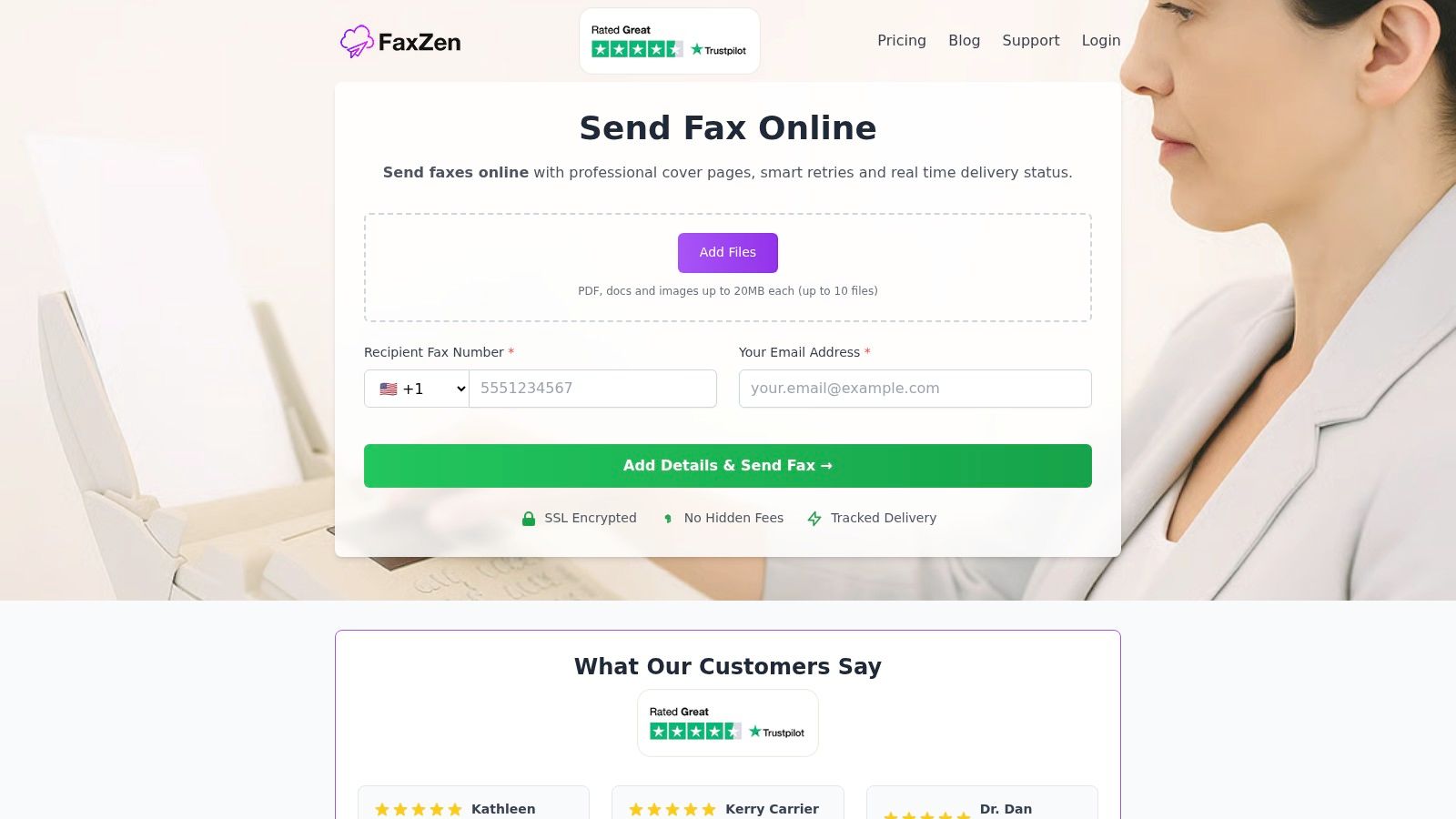
A no-account workflow can reduce the amount of personal information connected to a long-lived fax inbox. That doesn't make the process automatically safe. It does make documented deletion, payment security, and receipt handling easier to evaluate because the service has fewer persistent features to hide behind.
The strongest pay-per-use design addresses specific operational risks. Encryption in transit protects the upload during transfer. Automatic deletion after a defined period limits lingering copies. Secure card processing keeps payment details away from the fax workflow. Branded cover pages prevent an improvised first page from looking unprofessional. Timezone-aware scheduling helps avoid sending at an unsuitable local hour, while retry logic gives a failed connection another chance.
A service such as FaxZen documents these controls, including 256-bit SSL encryption in transit, automatic deletion after 24 hours, Stripe-backed payments, branded cover pages, timezone-aware scheduling, intelligent retry logic, real-time tracking, and email confirmations with the original document attachment. Review the broader pay-per-use online fax model before deciding whether a subscription is justified.
The right principle is simple: pay for the evidence when evidence is part of the job. Don't pay monthly for features you won't use, and don't accept “free” when the missing record could undermine the document you're sending.
How to Choose Any Online Fax Service Wisely
Use five checks before uploading a sensitive page. They work for free platforms, subscriptions, and pay-per-fax services.
Check the receipt
A passing service distinguishes upload acceptance from final delivery. The receipt should show the destination, transmission time, final status, and confirmation result. If it only gives you a reference number for an uploaded file, treat it as incomplete.
Check the connection
Look for disclosed TLS information, not just an old “SSL” badge. NIST's guidance makes TLS 1.3 the preferred target, with TLS 1.2 as a practical minimum for compatible systems. The provider should also explain storage encryption and access controls.
Check retention
Ask how long original files, failed attempts, email attachments, recipient data, and logs remain available. Retention should be specific enough for you to decide whether a document belongs in the service at all.
Check deletion
Find the deletion path before sending. A clear policy should cover temporary files and completed documents, not just the visible history screen. If deletion requires an unclear support request, the workflow carries more exposure.
Check the send model
A true one-time send is useful for a freelancer, attorney, patient, or small business that faxes rarely. Account creation can make sense for recurring teams, but it also creates a persistent document and identity trail.
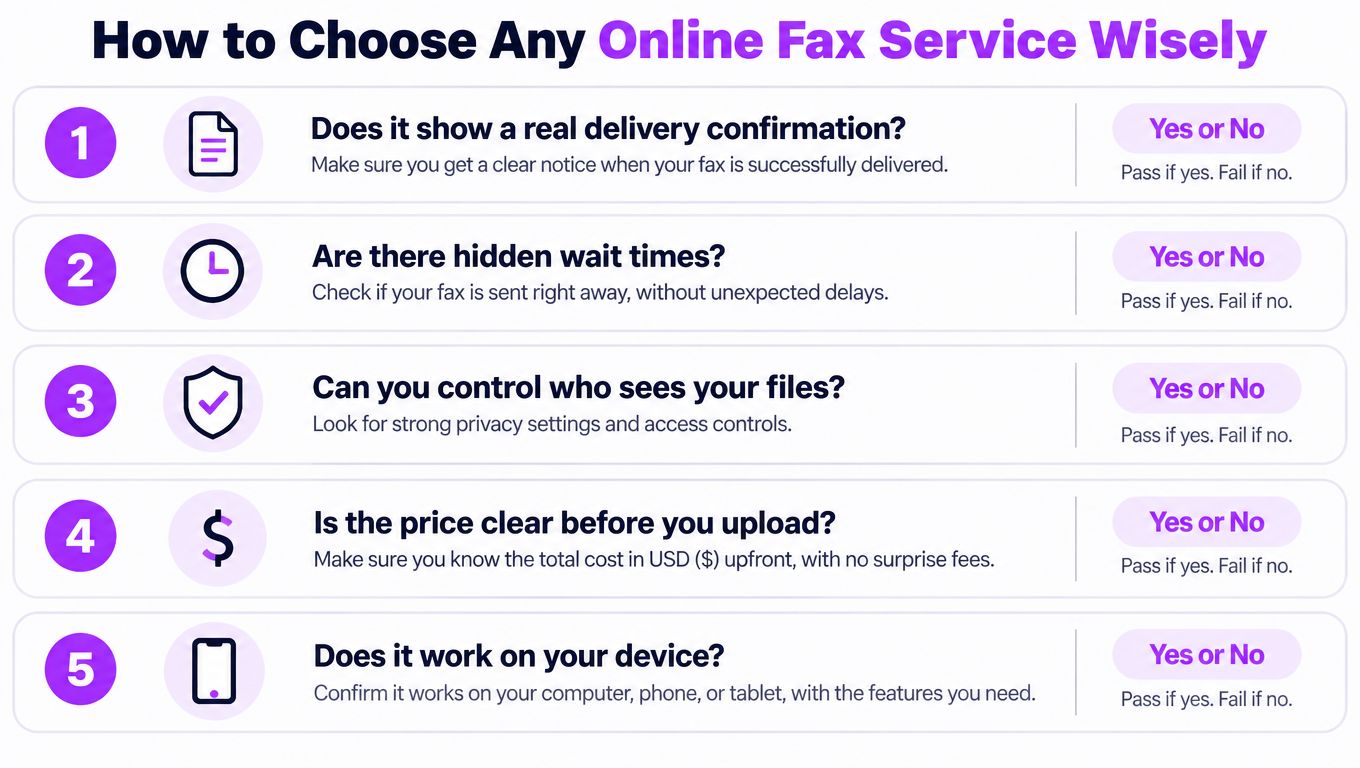
Match the standard to the document. A casual note may tolerate a basic workflow. A contract, tax filing, banking document, or medical record needs recipient verification, controlled access, a defined retention window, and defensible delivery evidence. FaxZen is one reference example of a pay-per-fax workflow built around those checks, but the questions matter more than the brand.
Frequently Asked Questions About Free Online Fax
Is sending a promotional fax the same as sending a contract?
No. The FCC treats unsolicited fax advertisements differently from ordinary transactional documents. Under its fax advertising policy, permission or an established business relationship may be required for advertising transmissions.
What must an advertising fax include?
The first page must contain a clear opt-out notice, contact information, and a cost-free way to stop future advertisements. The mechanism must operate continuously, and the sender must honor a request within the shortest reasonable period, never exceeding 30 days, as explained in the FCC's junk fax FAQ.
Does international faxing change the delivery question?
It can. The transmission may involve connection, image transfer, confirmation, and retransmission stages across different networks and countries. Choose a service that records the final result rather than treating the initial upload as completion.
Who is responsible for the fax?
The sender remains responsible for the recipient number, document classification, consent where required, and handling of the resulting record. A free platform doesn't transfer those obligations.
FaxZen offers account-free, pay-per-fax sending with delivery status, email confirmation, document deletion after 24 hours, and support for international destinations. If you need a practical alternative to a vague free tier, visit FaxZen and send the document with evidence you can keep.