
A Guide to Your Medical Records Request Form

Table of Contents
A medical records request form is the official document you use to ask a healthcare provider for a copy of your personal health information. Think of it as the formal key that unlocks access to your medical history. This document initiates a legal process, granting the provider your explicit permission to release your records—whether to you, another doctor, or a third party like an insurance company. It's a critical tool for managing your health, ensuring continuity of care with a new physician, or handling legal and insurance matters.
Ready To Fax?
Start sending faxes online in seconds with FaxZen - No account required
Send Fax Now 🚀Need a secure, reliable way to send your completed form? FaxZen offers a simple, machine-free solution to fax your documents with real-time tracking and delivery confirmation. Visit faxzen.com to send your first fax in minutes.
Understanding the Form's Purpose
The medical records request form is more than just paperwork; it’s a crucial safeguard for your protected health information. Its primary function is to create a documented, legal trail that verifies your identity and confirms your consent to release sensitive data. This structured process protects both you and the healthcare provider by ensuring your private information is shared only with authorized individuals or organizations. Its importance extends beyond personal access, as insurance companies rely on these forms to process claims, and legal teams may require them as evidence. Most importantly, when you switch doctors, this form facilitates the smooth transfer of your medical history, enabling your new provider to offer the best possible care.
Key Components of a Standard Form
Every medical records request form contains several essential sections designed to gather the specific information needed to process your request accurately and securely. Familiarizing yourself with these components will help you complete the form correctly and avoid unnecessary delays. Typically, the form is divided into distinct parts, each serving a unique purpose in the verification and fulfillment process.
A standard form will ask for detailed patient information to confirm your identity, including your full name, date of birth, and contact details. It will also require recipient details, specifying exactly who should receive the records. This is followed by a section where you must detail the specific records you need, such as lab results from a particular date range or a specific surgical report. The form will also ask for the purpose of the request and your preferred delivery method. Finally, and most critically, it requires your authorization signature to provide legally binding permission for the release.
| Section | What It Means and Why It Matters |
|---|---|
| Patient Information | This verifies your identity. Your full name, date of birth, and contact info are required to ensure the correct records are pulled from the right file. |
| Recipient Details | This tells the provider exactly who should get the records, preventing your sensitive info from being sent to the wrong party. |
| Records Requested | This is the core of your request. Be specific about documents and dates to speed up the process. |
| Authorization Signature | This is your legally binding permission. Without a valid, dated signature, the request is null and void. |
How to Complete Your Form with Precision
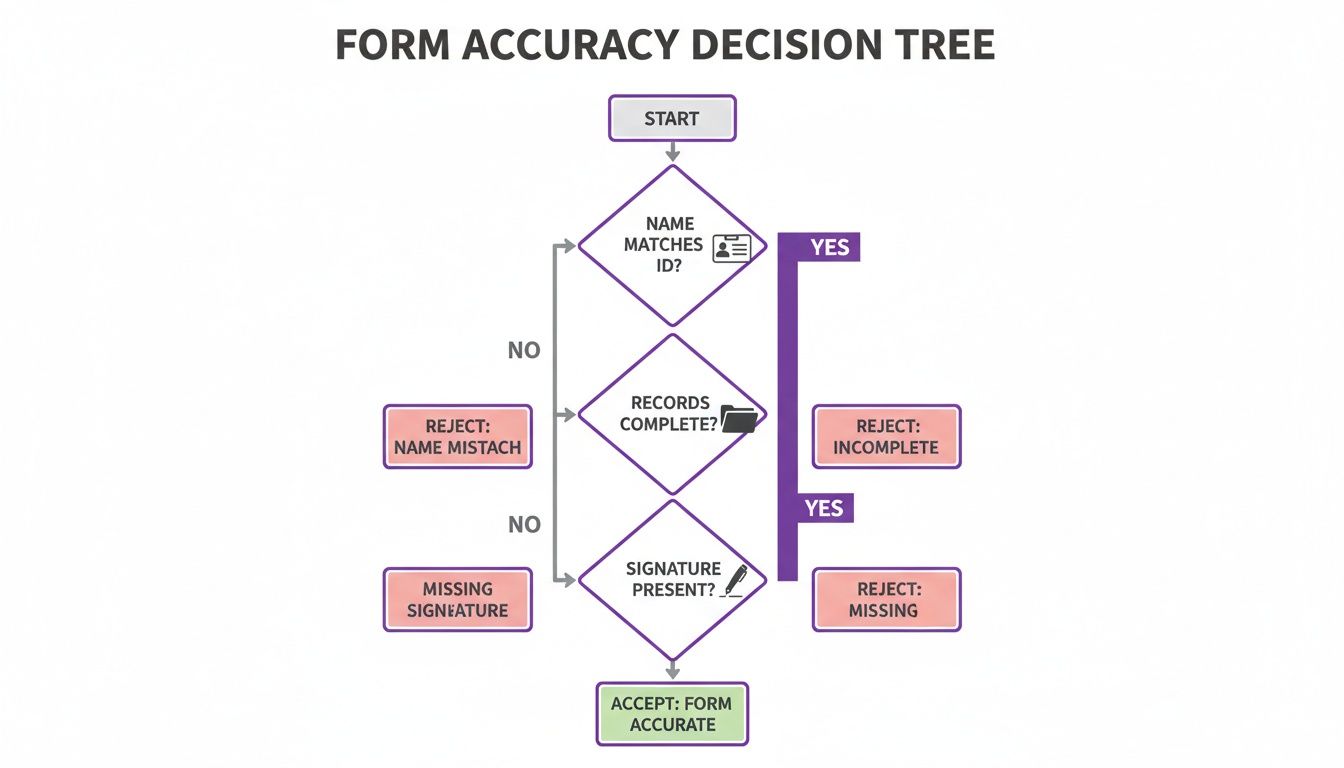
Getting the details right on a medical records request form is crucial for avoiding delays. Start with the basics: your full legal name, date of birth, and any other names you might have used at that facility, such as a maiden name. Using block letters if filling it out by hand, or typing into a fillable PDF, is the best way to prevent misinterpretation. A simple mistake like a misspelled name or a wrong digit in your birthdate can lead to a rejection of your request. Take a moment to double-check that your current contact information is correct, as this can save you weeks of back-and-forth communication.
Pro Tip: If you're not sure which documents you need, call the medical records department. While they can't offer medical advice, they can often clarify what reports are typically included for a specific condition or procedure, which can save you from submitting a second request later.
When specifying the records you need, precision is key. A vague request like "all my records" can cause confusion, lead to unnecessary fees, and slow down the entire process. Instead, pinpoint exactly what you are after, such as "All lab results from January to June 2023" or "Surgical report for appendectomy on May 5, 2022." Including a clear date range helps staff locate your documents quickly. The authorization section is the most critical part, as your signature provides legally binding consent. Ensure you sign your full name and write the current date. If requesting records for someone else, you must attach the legal paperwork proving you have the authority to do so. Our guide on creating a fax cover page template can also help you keep everything professional.
Choosing a Secure Submission Method
Once your form is complete, deciding how to submit it is a critical step that impacts both speed and security. Traditional postal mail is an option, but it is slow and lacks tracking. In-person delivery is highly secure but often impractical. Many modern clinics offer patient portals for direct uploads, but functionality can be limited. Standard email is a significant privacy risk and should be avoided unless the provider explicitly confirms it as a secure method.
For decades, faxing has been a trusted standard in healthcare because it provides a secure, point-to-point connection. Unlike email, which can be intercepted as it travels across various servers, a fax creates a direct link between sender and recipient. Modern online fax services, like FaxZen, combine this trusted security with digital convenience, offering speed and a clear audit trail. This balance of near-instant transmission and robust security makes it an ideal choice for sensitive documents like a medical records request form. For more on data protection, our article on HIPAA-compliant document sharing offers valuable insights.
Following Up On Your Request
After submitting your medical records request form, the provider generally has up to 30 days to fulfill it, though many states mandate a faster turnaround. The actual timeline often depends on the complexity of your request. A single lab result might arrive in days, while a comprehensive history could take several weeks. If you used a secure online fax service, your delivery confirmation provides a useful reference point for any follow-up communication.
It's reasonable to make a polite phone call to the medical records department if a week passes without any acknowledgment. When you call, have your full name and date of birth ready and simply ask for a status update. Be aware that providers may charge a "reasonable, cost-based fee" to cover labor and supplies, though this is often waived if the records are for continuity of care. You can usually find the fee schedule on the provider's website. Mastering this final stage ensures you stay in control until the records are securely in your hands. For more details on secure electronic transmission, our guide on HIPAA-compliant eFax solutions is a helpful resource.
Frequently Asked Questions
1. Can a healthcare provider charge me for my records? Yes, providers can charge a "reasonable, cost-based fee" for copies, which typically covers labor, supplies, and postage. However, many states have laws that cap these fees.
2. Can someone else request my records on my behalf? Yes, but only with proper legal authorization. A designated representative needs a signed authorization from you or legal proof like a power of attorney. You can learn more in our guide to HIPAA-compliant healthcare faxing.
3. Do I need to provide a reason for requesting my records? While most forms include a section for the purpose, you generally don't have to give a detailed reason for personal use. Simply writing "personal use" or "continuity of care" is sufficient.
4. How long does it take to receive my records? Providers typically have up to 30 days to fulfill a request. The actual time can vary based on state laws and the complexity of the request.
5. What happens if I make a mistake on the form? If there is an error, the provider will likely return the form for correction, causing a delay. Common mistakes include missing signatures, incorrect dates, or vague record specifications.
Related Articles
- How To Fill Out a Medical Release Form
- The Ultimate Guide to Secure Document Sharing
- What is a Fax Cover Sheet and When Do You Need One?