The Ultimate Guide to Secure eFax Services
Table of Contents
- Why Faxing Still Dominates in Professional Settings
- Decoding the Technology Behind Secure eFaxing
- The Critical Role of Administrative and Physical Safeguards
- How to Confidently Vet an eFax Provider
- Implementing eFax Best Practices in Your Daily Workflow
- FAQ: Your Secure eFax Questions Answered
- Related Articles
It might feel like a throwback, but believe it or not, the humble fax is still a powerhouse in modern business and healthcare. Why? It's a widely accepted method for shipping sensitive documents between different offices, clinics, labs, and insurance companies. This old-school reliability has paved the way for something much more modern: secure eFax services that blend the familiarity of faxing with the data security today’s world demands.
Ready To Fax?
Start sending faxes online in seconds with FaxZen - No account required
Send Fax Now 🚀Ready to upgrade your faxing workflow? Discover the ease and security of a modern faxing solution with FaxZen.
Why Faxing Still Dominates in Professional Settings
In industries wrapped in strict privacy rules, the traditional office fax machine can be a huge liability. Think about it: a piece of paper with sensitive patient or client info just sitting in a shared tray is a data breach waiting to happen. Anyone walking by can see it, grab it, or even just read it over someone's shoulder. And we've all heard the horror stories of misdialing a number and sending confidential records into the void with zero chance of getting them back.
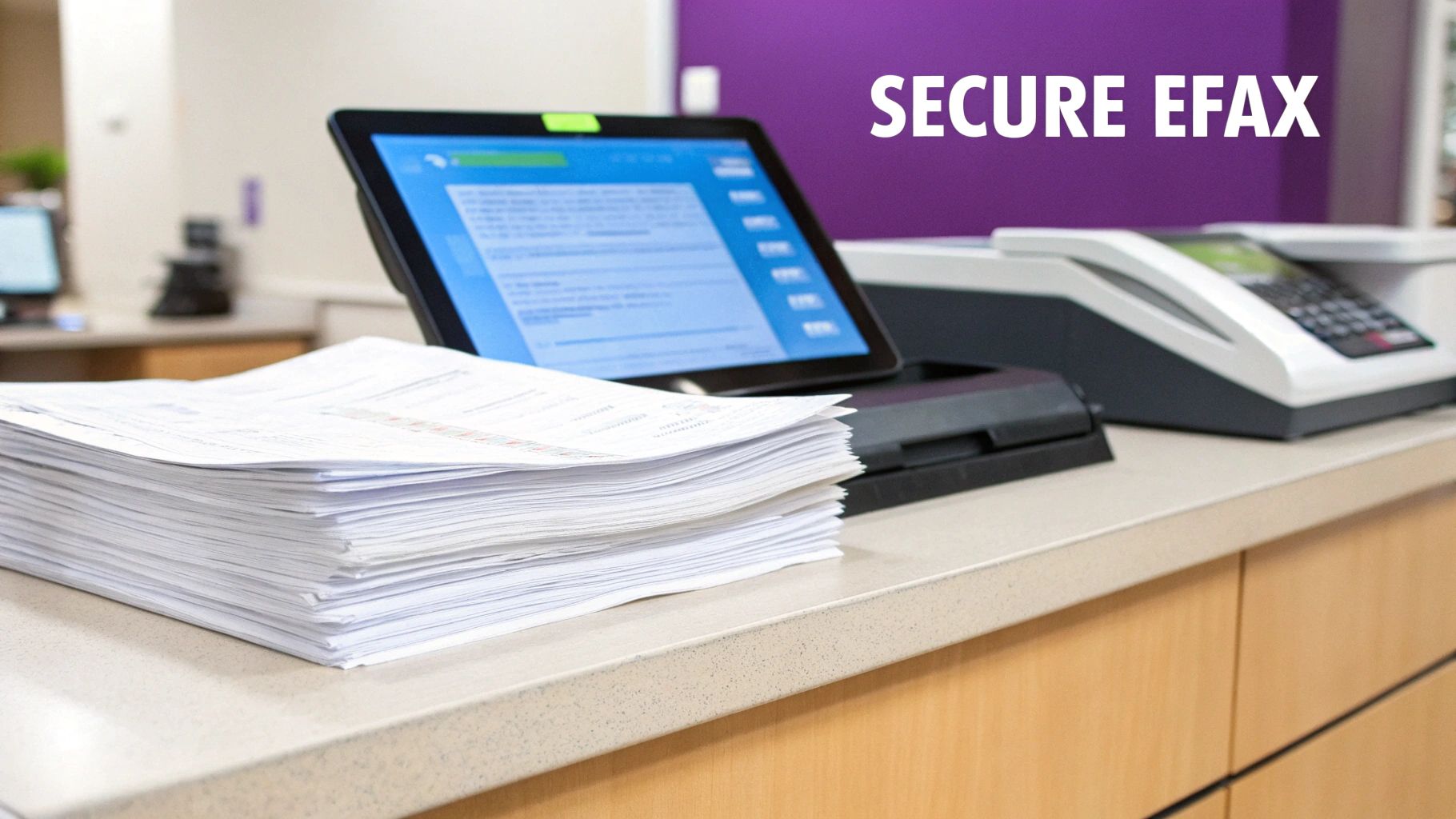
This is precisely where secure eFax comes into play. It’s not just about sending a file from point A to point B. It’s about creating a secure, traceable journey for that information. It's like swapping a paper ledger left on a public counter for an encrypted, access-controlled digital vault. This shift lets organizations keep the simple faxing workflow they know while adopting the serious security measures required for handling sensitive data.
Even with the big push for going digital, faxing is still a bedrock of professional communication. The market for secure fax solutions is already worth billions and is set to keep growing strong through 2032. This isn't surprising when you realize that over 80% of businesses still rely on it, especially in sectors where regulations are only getting tighter.
A secure eFax service directly addresses the weak points of old-school machines. Instead of printing out a physical document for anyone to see, it drops the file directly into a secure, password-protected digital inbox. That simple change completely removes the risk of someone snooping on a physical copy. Better yet, it creates a clean audit trail, logging exactly who sent what, when it was sent, and confirming it was delivered. For any business wondering "where can I send a fax" securely, these services are the clear, reliable answer.
Decoding the Technology Behind Secure eFaxing
What really separates a secure eFax service from one that's just a digital postcard? It’s not one single feature, but a stack of powerful, non-negotiable security technologies all working together. At its core, a truly secure online faxing platform is built on a foundation of military-grade encryption, hardened infrastructure, and strict access controls that shield sensitive information at every point in its journey.
To be considered secure, an eFax service can't just slap a label on its website. It needs to prove it has specific technical safeguards in place. These aren't just buzzwords; they are the digital locks, vaults, and security guards protecting your important data.
Let's break down the essential technologies you should look for.
Callout: Modern eFax services provide robust security features that traditional fax machines simply cannot match. From encryption to audit trails, these tools are designed to protect your most sensitive documents.
The absolute cornerstone of secure eFaxing is end-to-end encryption. Think of it like an armored truck. When you send a document, it’s immediately locked inside an impenetrable digital safe before it even leaves your computer. That safe remains sealed tight for the entire journey. Only the intended recipient has the key to unlock it. The industry gold standard is AES 256-bit encryption—a military-grade protocol used to protect classified information. This ensures your documents are secure both while traveling (in transit) and while stored on a server (at rest).
Where your data lives is just as important as how it travels. Reputable providers house their servers in highly secure, often unmarked, data centers. These aren't just rooms with servers; they are fortresses, complete with biometric scanners, 24/7 video surveillance, and strict, audited access protocols. These data centers also have powerful digital defenses like intrusion detection systems that monitor network traffic for anything suspicious and block potential threats before they can do any harm.
All the best technology in the world is useless if the wrong people can get their hands on it. This is where strong access controls come in, ensuring that only authorized individuals can view or send faxes. A critical feature here is multi-factor authentication (MFA). This requires you to provide at least two pieces of evidence to prove your identity—like your password and a one-time code sent to your phone. It adds a powerful layer of security, making it exponentially harder for an attacker to compromise an account.
The Critical Role of Administrative and Physical Safeguards
While powerful encryption is the engine of a secure eFax service, it's the administrative and physical safeguards that act as the steering wheel and brakes. These controls guide the technology, ensuring it’s used responsibly and accountably. They transform a technically secure tool into a genuinely reliable solution by focusing on human accountability and operational integrity.
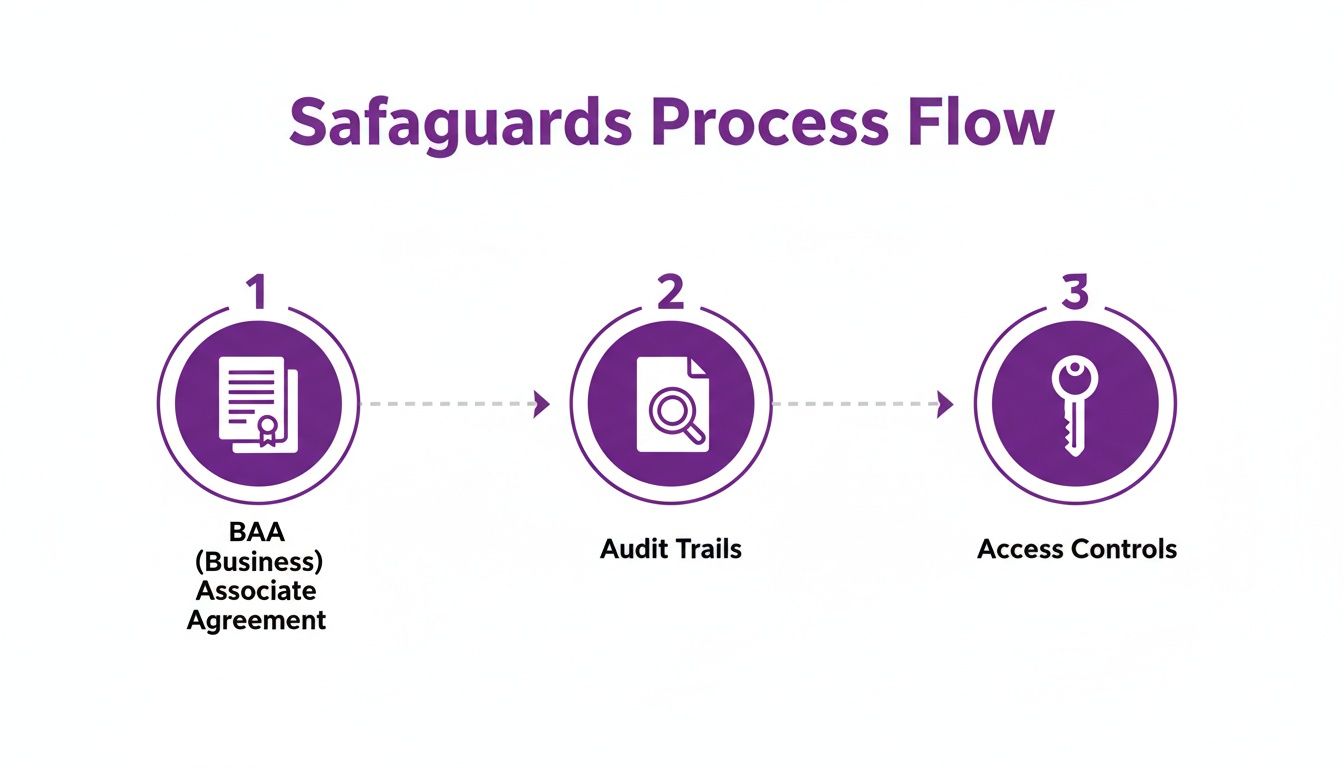
For certain industries, a Business Associate Agreement (BAA) is a crucial component. This is a legally binding contract that makes your eFax provider a true partner in protecting sensitive data. A BAA is often mandatory in regulated fields and holds providers to specific standards for breach notification, data handling, and security protocols, making it a cornerstone of your compliance strategy.
Think of the BAA as the formal handshake that establishes accountability. When you sign one with an eFax provider, they are legally obligated to protect information with the same rigor you do. This critical agreement outlines exactly how they will handle protected data and what happens if a breach occurs. Without a signed BAA in applicable situations, you're handing over sensitive files with no legal assurance they'll be protected.
Beyond contracts, effective administrative controls provide constant oversight within the platform itself. This is where detailed audit trails and strict user access controls become indispensable. A detailed audit trail acts like a digital surveillance system, creating an unchangeable log that records every action: who sent a fax, who viewed it, and when it was delivered. Robust access controls allow you to assign specific permissions to each user, ensuring that employees can only view or send faxes relevant to their roles, which dramatically reduces risk. You can explore more on this topic by reading about fax machine security.
How to Confidently Vet an eFax Provider
Choosing the right eFax provider isn't about picking the one with the flashiest website. It's about digging into their security architecture to see if they're truly built to protect sensitive data. A trustworthy service will be upfront about its safeguards and won't hesitate to provide documentation.
Once you've confirmed any necessary legal agreements, it's time to pop the hood and look at the provider's technical security measures. These are the digital locks, alarms, and cameras that actively protect your data around the clock. Ask potential vendors if they use AES 256-bit encryption for data "at rest" and TLS 1.2 or higher for data "in transit." These are the current gold standards for data protection.
You also need to ask about the physical security of their data centers. Where is your data actually living? Reputable providers use secure facilities with multiple layers of protection like biometric scanners, 24/7 surveillance, and strict entry protocols. Certifications like SOC 2 Type II are a good sign, as they provide an independent stamp of approval on these controls.
Finally, make sure the provider offers detailed audit trails. You need a complete log that tracks every single action taken on a fax—who sent it, who viewed it, and when. This level of visibility is absolutely essential for accountability and for tracing the source of any potential security incident. You can check out our online fax service comparison to see how various providers measure up on these critical features.
Implementing eFax Best Practices in Your Daily Workflow
Picking a secure eFax service is a great start, but the technology is only half the battle. Real security isn't just about the tool; it's about how your team uses it every single day. Weaving best practices into your daily workflow is what turns a secure platform into a truly protected process.
| Action | Best Practice | Rationale |
|---|---|---|
| Sending | Always double-check the recipient's number against a verified source before transmitting. | Prevents accidental disclosure of sensitive data due to simple typos or outdated contact information. |
| Cover Sheet | Use a standardized cover sheet with a confidentiality statement on every fax. | Provides clear instructions and a legal notice to anyone who may receive the fax in error. |
| Access | Log out of the eFax platform immediately after use, especially on shared computers. | Minimizes the risk of unauthorized access by other individuals who may use the same workstation. |
Even with the most advanced encryption, the biggest weak link is often simple human error. One mistyped digit can send a sensitive document to the wrong number, creating an instant data breach. This is why establishing and enforcing clear, consistent procedures isn't just a suggestion—it's absolutely critical.
A foundational practice is rigorous recipient verification. Staff should get into the habit of never sending a fax to a new number without first confirming it through another channel, like a quick phone call. For numbers you fax often, build a pre-approved address book inside your eFax service. It’s a simple step that all but eliminates typos and misdials. Also, get in the habit of using a secure cover sheet for every single fax. This sheet should have your contact info and a confidentiality notice, but it's best practice to avoid including sensitive details on the cover itself. For a refresher on the technical side, take a look at our guide on how to send an online fax securely.
FAQ: Your Secure eFax Questions Answered
Can I just use any eFax service for sensitive documents?
No, this is a common and risky mistake. Standard online fax services are often built for convenience, not for protecting sensitive information. For documents requiring a high level of security, a service must have a specific architecture, including features like end-to-end encryption and detailed audit trails. For certain industries, the provider must also be willing to sign a Business Associate Agreement (BAA).
Is faxing over email secure?
Standard email is generally not a secure way to send sensitive data. However, a true secure eFax service changes the game. When you use their email-to-fax feature, the service acts as a secure intermediary. The content is encrypted during transit and only becomes readable to the intended recipient on their fax machine or secure portal.
What is the most important thing to look for in a provider?
While top-notch encryption is non-negotiable, for many regulated industries, the real deal-breaker is the Business Associate Agreement (BAA). This is a legally binding contract that makes the vendor officially responsible for protecting sensitive data according to specific regulations. If a provider in such a field won't sign a BAA, you should find one that will.
Can I securely eFax from a mobile phone?
Yes, it's possible to fax securely from your phone, but only if the provider has a robust security framework. Secure mobile eFaxing combines strong server-side protections with security features inside their app. This means all transmissions must use end-to-end encryption, the app should enforce multi-factor authentication for logins, and no sensitive data should be stored locally on your phone's file system.
Do I still need to use a fax cover sheet?
Yes, you absolutely should. A fax cover sheet is still a critical best practice. It should always include a confidentiality notice and your contact information. However, it's key to never put any highly sensitive details on the cover sheet itself. Its job is to serve as a clear warning just in case the document accidentally lands in the wrong hands.
Related Articles
- Where Can I Send a Fax: A Guide to Modern Faxing Locations
- Is Faxing Over Wi-Fi Secure? What You Need to Know
- Online Fax Service Comparison: Finding the Right Fit for You
Ready to upgrade to a modern, secure faxing solution? FaxZen provides a straightforward, pay-as-you-go platform with the security you need for your important documents. Visit faxzen.com to send your first fax in minutes.