Document Retention Policy for Law Firms: How to Build One
Table of Contents
- Retention Periods for Client Files Across Jurisdictions
- How to Build the Schedule in Five Steps
- When a Litigation Hold Stops Routine Deletion
- Securing Records and Vetting Storage Vendors
- Draft the Policy and Run Your First Destruction Cycle
- Quarterly Checks That Prove the Policy Works
- Questions Law Firms Ask About Retention Policies
Meta title: Document Retention Policy for Law Firms | Practical Guide
Meta description: Build a jurisdiction-aware retention schedule, enforce holds, protect client access, and document authorized destruction.
Author: FaxZen staff
Reading time: 5 minutes
Ready To Fax?
Start sending faxes online in seconds with FaxZen - No account required
Send Fax Now 🚀Keeping every file for seven years isn't a document retention policy for law firms. There's no single national period for complete client files. Start with jurisdiction, record type, and preservation obligations, not an automatic deletion date.
Need to send signed records quickly? Visit our online fax service.
Retention Periods for Client Files Across Jurisdictions
A flat seven-year rule mixes unlike clocks. ABA Formal Opinion 471 separates the complete client file from financial and property records, so a trust or property deadline cannot serve as permission to destroy the whole file.
Baseline retention periods by jurisdiction and record type
| Record or jurisdiction | Period | Basis |
|---|---|---|
| ABA Model Rule 1.15 financial and property records | 5 years after termination | Financial and property records only |
| California client funds and property | 5 years after final appropriate distribution | California Rule 1.15 |
| Original deeds, securities, promissory notes | Indefinite | Continuing legal significance |
| Litigation or investigation records | Until written hold release | Hold override |
| Other jurisdictions or matters | Set from the applicable statute, court rule, ethics opinion, contract, or malpractice-limitation period | No national client-file period |
Classify each matter by jurisdiction, record type and hold status before assigning a date, then apply the longest clock and record who authorized destruction and how the client was notified. Treat regulatory compliance obligations as inputs to that row.
How to Build the Schedule in Five Steps
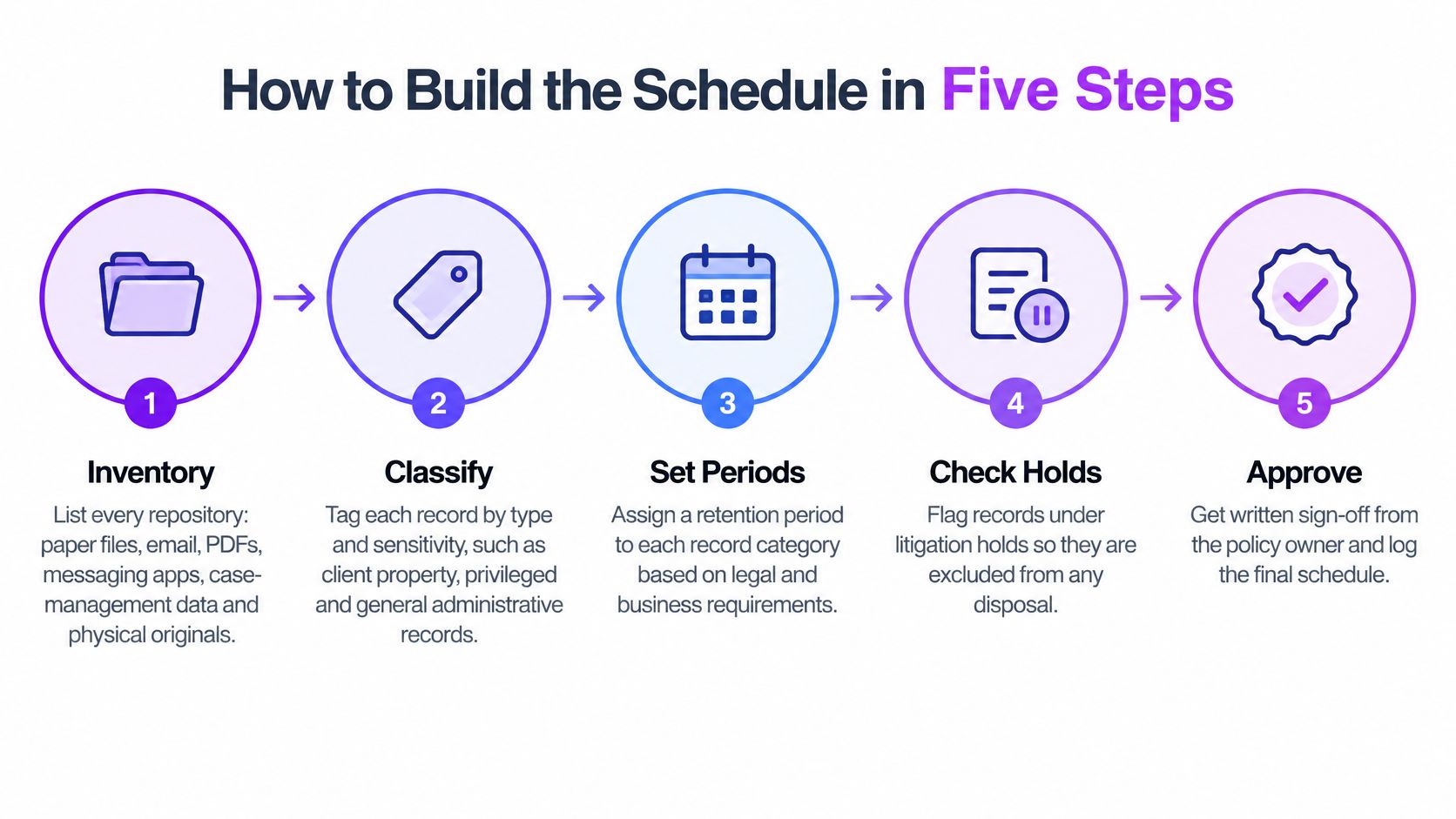
Use a classification-and-exception workflow consistent with Alabama's file-retention guidance.
- Inventory paper, email, PDFs, messaging, case-management data, and originals.
- Classify significant originals, working records, and held materials.
- Apply the longest professional, state, contractual, operational, or malpractice-limitation requirement.
- Record the trigger, such as closing or final distribution, not upload.
- Obtain partner and records-manager approval; check holds before deletion.
Say a Chicago family-law firm handles a New York matter and maintains a California trust account. The reported Illinois and New York periods provide file-schedule inputs; the trust ledger's distribution-based clock might expire later. Keep the matter through the longest applicable clock.
Configure digital filing systems with a row per matter type, named owner, trigger, and review date.
When a Litigation Hold Stops Routine Deletion
A schedule isn't immunity. The Federal Bar Association's discussion describes the 2006 electronic-discovery amendments and limited Rule 37 safe harbor for routine, good-faith loss, not permission to ignore preservation duties.
Stop deletion for claims, investigations, subpoenas, audits, or reasonably foreseeable disputes. The attorney issues the hold, names custodians and sources, including email, document systems, phones, and backups, and obtains acknowledgments. Mark the matter held; require written attorney release.
Backups aren't holds. Duplicate copies may contain unique metadata, including evidence relevant to court-document filing.
Following the schedule doesn't excuse destruction after a preservation duty arises.
Securing Records and Vetting Storage Vendors
Classify client property, privileged strategy, identifiers, and correspondence before choosing storage. ABA Opinion 477R requires reasonable confidentiality precautions, sometimes heightened by sensitivity, agreement, or law; Opinion 498 addresses retrievable archives and continuing platform security.
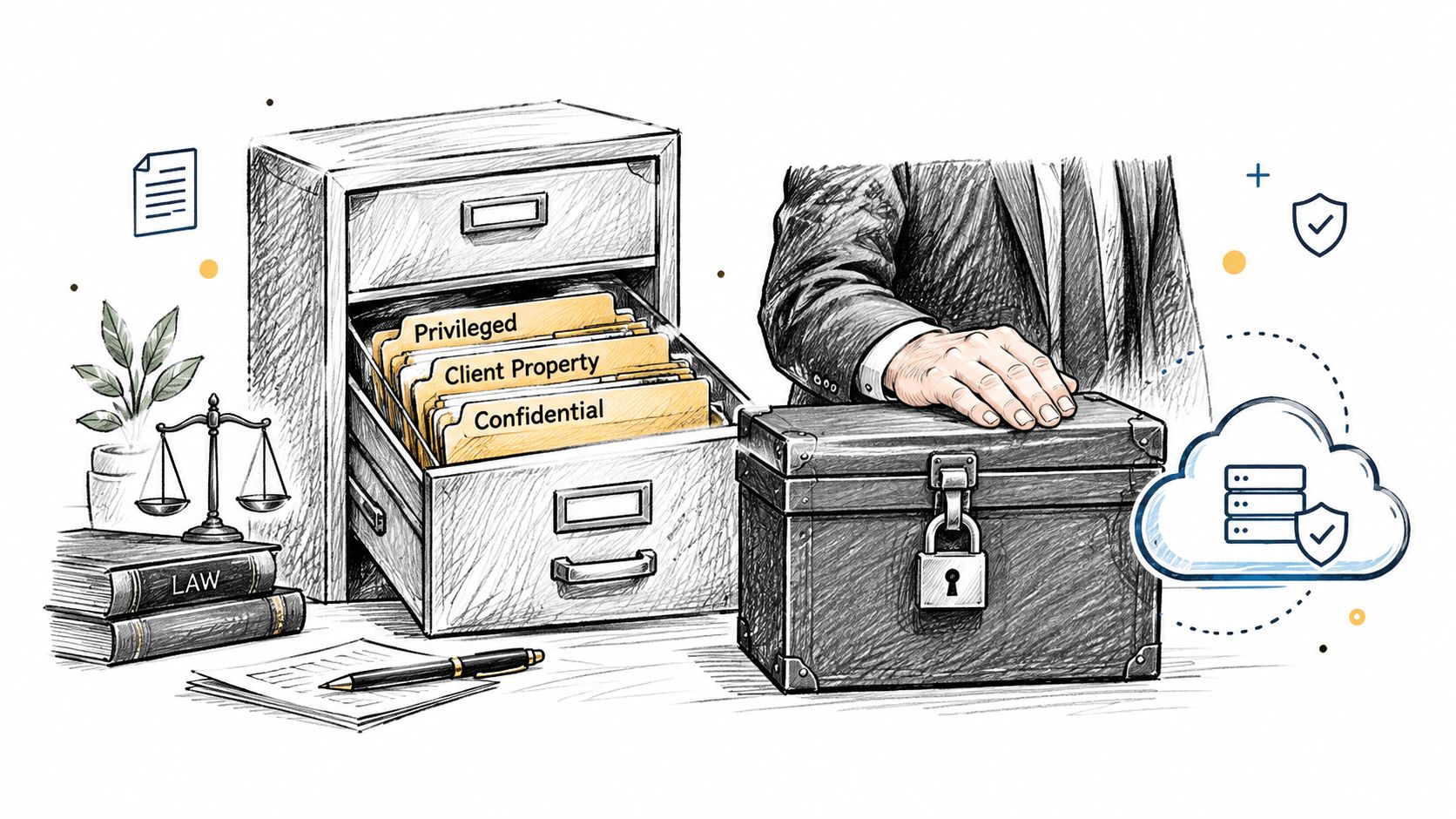
- Access: Restrict by matter and role; encrypt sensitive attachments.
- Clients: Document agreed security expectations.
- Vendors: Check archive terms and backup disposition before signing.
- Temporary copies: Obtain written fax/email upload-deletion terms; log sender, recipient, and time.
A secure file-transfer workflow must address shadow archives, not just transmission.
Draft the Policy and Run Your First Destruction Cycle
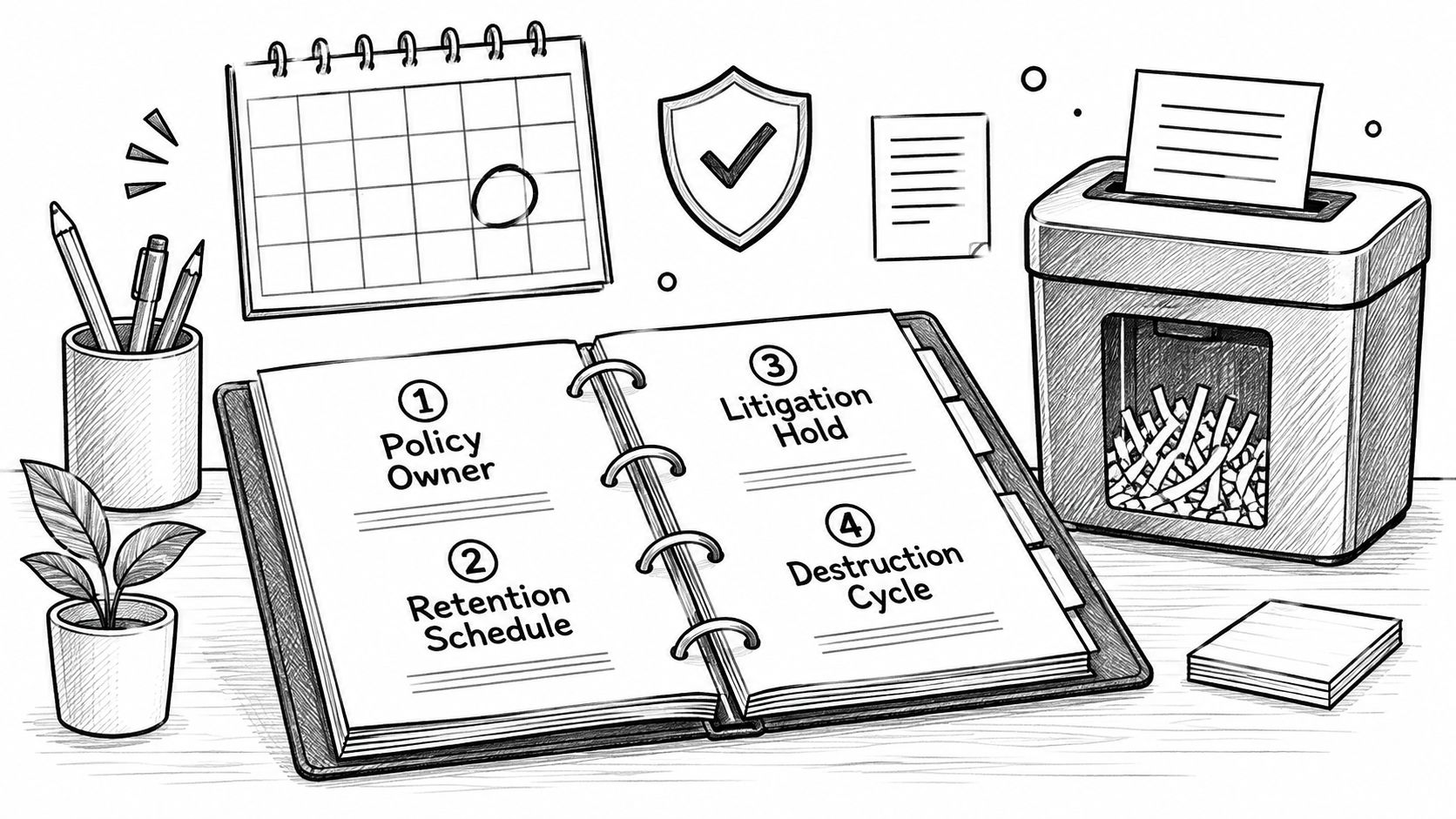
Draft in order: 1. Owner and all-office scope. 2. Schedule. 3. Holds and release authority. 4. Client notice and return. 5. Pilot destruction, for example, on about twenty closed matters.
Use this lifecycle as a drafting checklist.
Records subject to a legal hold are not destroyed until the responsible attorney releases the hold in writing, whatever the scheduled disposition date.
Before any destruction, the firm will notify the client in writing, offer return of original documents, and record the authorization in the destruction log.
Alabama's electronic-file guidance supports meaningful client access and policy communication at engagement and closing. Test complete exports, including communications, scanned exhibits, delivery confirmations, and metadata. For delegated preparation, virtual legal assistants from Virtual Legal Assistants are an option; retain attorney approval.
Use the video alongside the written procedure.
Destruction log fields
| Log field | What to record |
|---|---|
| Matter and record class | Matter ID and schedule category |
| Trigger and disposition date | Starting event and calculated destruction date |
| Rule applied | Governing rule, statute, or hold |
| Hold check | No active hold, audit, or dispute |
| Client notice | Notice date and originals returned |
| Authorization | Two named approvers, destruction method and date |
The log proves each destruction was authorized.
Quarterly Checks That Prove the Policy Works
Use these operational targets, with integrity and audit controls informed by NARA's electronic-records criteria.
| Benchmark | Quarterly target | How to test |
|---|---|---|
| Classified active matters | 100% | Compare open matters with schedule |
| Acknowledged holds | 100% | Match register and acknowledgments |
| Held-matter automated deletions | Zero | Run exception report |
| Closed-file retrieval | Documented sample | Check content and metadata |
| Staff training | 100% annually | Compare training and staff lists |
Keep source records and metadata until migration is validated. Include fax transmission reports in retrieval tests.
- Jurisdiction: Don't apply the wrong period.
- Duplicates: Preserve unique metadata.
- Backups: Don't substitute them for holds.
- Originals: Return client property before destruction.
Training and testing are controls, not administration.
Questions Law Firms Ask About Retention Policies
Can one period cover everything? No. A workable schedule classifies each file by jurisdiction, record type and matter, then checks hold status before any retention date is treated as actionable.
What if the client can't be located? Document every notice attempt, and keep significant originals rather than destroying them until the matter's preservation and disposition requirements are confirmed.
Do emails count? Yes, when substantive. Routine messages and drafts may fall under an approved shorter schedule, but keep the thread and attachments needed to show what was decided.
Can an undisputed file be destroyed after its date? The date starts review. Destroy only after clearance, documented client notice and completed authorization.
Related Articles
- Windows: How to fax from PC
- Mac: How to fax from Mac
- iPhone: How to fax from iPhone
FaxZen offers online faxing for signed records without a fax machine. Visit FaxZen when fax delivery fits your workflow, and preserve the authoritative document and delivery evidence in your firm's repository.