Online Fax International: A Practical 2026 Guide
Table of Contents
- Why International Online Faxing Still Matters
- How International Online Fax Works
- Compare International Fax Coverage and Pricing
- Protect International Documents and Verify Delivery
- Handle Jurisdiction and Purpose Compliance
- Apply International Faxing to Real Workflows
- Use a Reliable Pre-Send Checklist
- Choose a Service and Send With Confidence
A small business owner has a signed contract ready for an overseas partner, and the recipient needs it by fax. Online faxing lets the sender submit a digital file without finding a machine. The harder part starts after the send button. A page can arrive successfully and still fail the job it was sent to do, so the sender has to answer where the document is going, whether fax is acceptable for the purpose, and what delivery confirmation proves.
Ready To Fax?
Start sending faxes online in seconds with FaxZen - No account required
Send Fax Now 🚀If you're preparing an international fax, this guide walks through the route, the cost and security trade-offs, and the delivery and compliance problems that are easiest to avoid.
Why International Online Faxing Still Matters
International faxing no longer requires a physical fax machine on the sender's desk. Instead, a service can take a digital document and deliver it into an established fax workflow abroad. Shared technical standards helped make this possible: the International Telecommunication Union approved successive fax standards, and Group 3 reduced transmission time to less than a minute, improving compatibility across national networks (fax technology history).
That compatibility still matters when an overseas recipient relies on fax for contracts, legal paperwork, healthcare records, financial documents, or government forms. The shift is from dedicated machines and phone lines toward online submission, not necessarily from fax to no fax at all.
The distinction to keep in mind is technical delivery versus practical and legal success. A transmission report may show that a receiving fax system accepted the pages, but it doesn't prove that the right person saw them, that the document is confidential end to end, or that fax satisfies a legal requirement. Treat each as a separate question as you prepare to send.
How International Online Fax Works
Think of online fax as a courier that repackages a digital document for a fax destination. You upload a PDF or image, enter the recipient's international fax number, and the service renders the file for transmission. Unlike ordinary email, the goal is delivery as a fax transmission to fax infrastructure.
The technical standards play different roles. T.4 defines image encoding, like the way the courier packages the pages. T.30 handles terminal identification, capability negotiation, page-by-page signaling, and confirmation. T.38 carries T.30 control and image data over IP, where a gateway can bridge the transmission to the destination's PSTN or ISDN network (fax relay and T.38). SIP or H.323 may establish the internet session; they don't replace T.30's fax-control role.
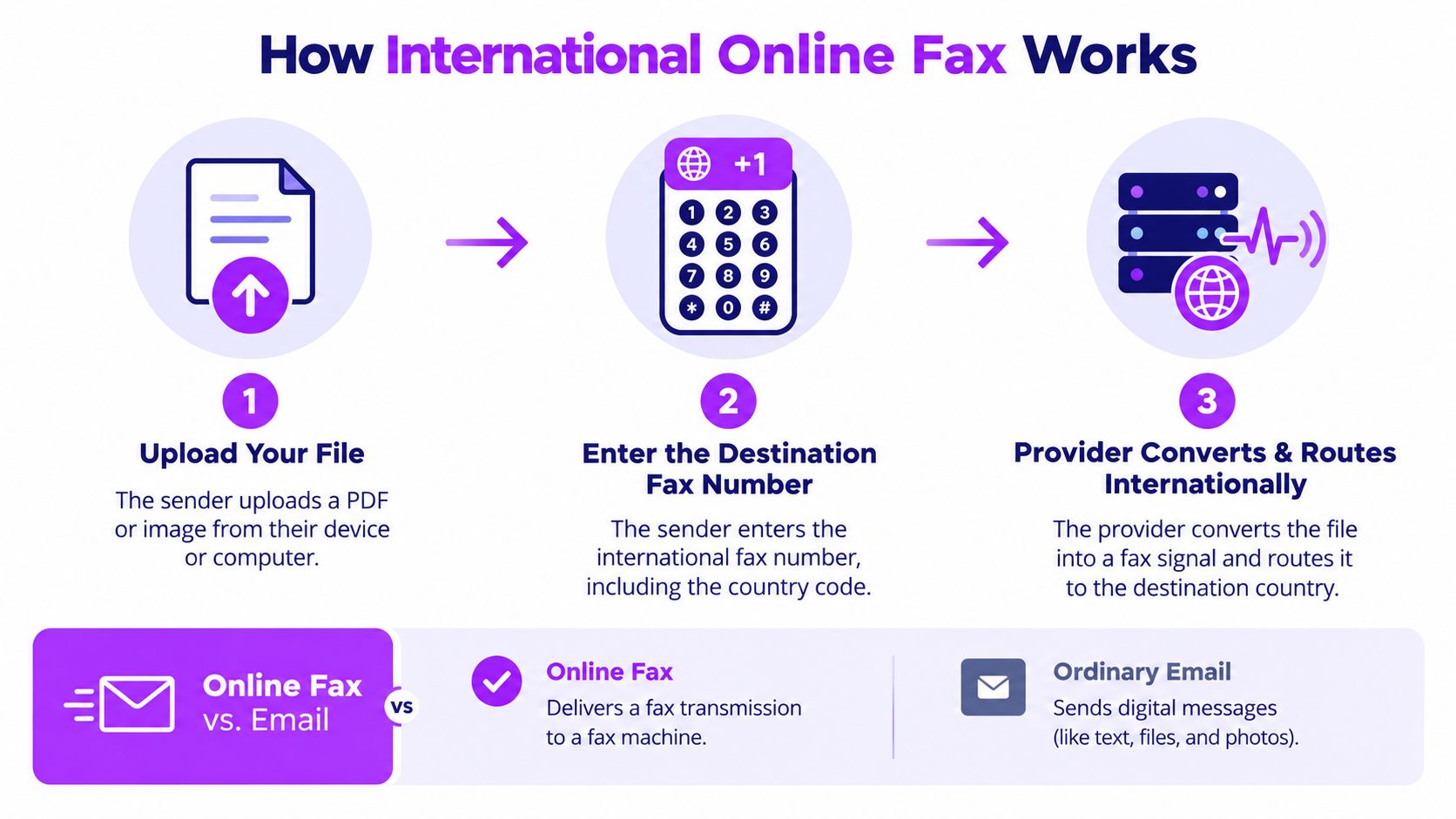
The practical sequence is upload, number entry, then conversion and routing. A successful upload only tells you that the service received your file. Look for the final transmission result, not just an upload receipt or connection attempt. For number formatting, see this guide to international fax number formats. If your question concerns legal service rather than document transmission, this explanation of serving legal papers via WhatsApp offers relevant context about how delivery method and legal process differ.
Compare International Fax Coverage and Pricing
Compare the full sending experience, not just the headline price. Country availability, number validation, page limits, destination charges, retries, and account requirements can affect what you pay or whether a send is possible. Confirm the final quote and any fees shown at checkout before you submit a sensitive or time-critical document.
| Pricing model | Best for | What to verify | Potential advantage |
|---|---|---|---|
| Pay per fax | Occasional senders | Destination price and retry treatment | Pay when needed |
| Credit package | People expecting repeat use | Credit terms and country coverage | Purchase credits in advance |
| Subscription | Regular, predictable sending | Included usage and overages | Set recurring access |
FaxZen's listed pricing starts at $8 per fax, or $15 for a 10-fax credit package; optional accounts support bulk credit purchases and credits that don't expire. Those prices shouldn't be assumed to cover every destination or any unlisted charges. When comparing payment options, this overview of online payment platform selection can help frame what to check at checkout. For destination-specific pricing considerations, consult international fax rates.
Protect International Documents and Verify Delivery
Security applies at several stages: while you upload the file, while a provider stores it, and when the fax travels onward. TLS protects a network connection between your browser and a service, but it doesn't automatically encrypt the conventional fax segment after a gateway sends the document onward. The UK Information Commissioner's Office advises evaluating encryption, secure storage, deletion after delivery, audit trails, and the provider's secure operating environment. It also cautions that ordinary fax messages aren't encrypted throughout transmission (ICO encryption guidance).
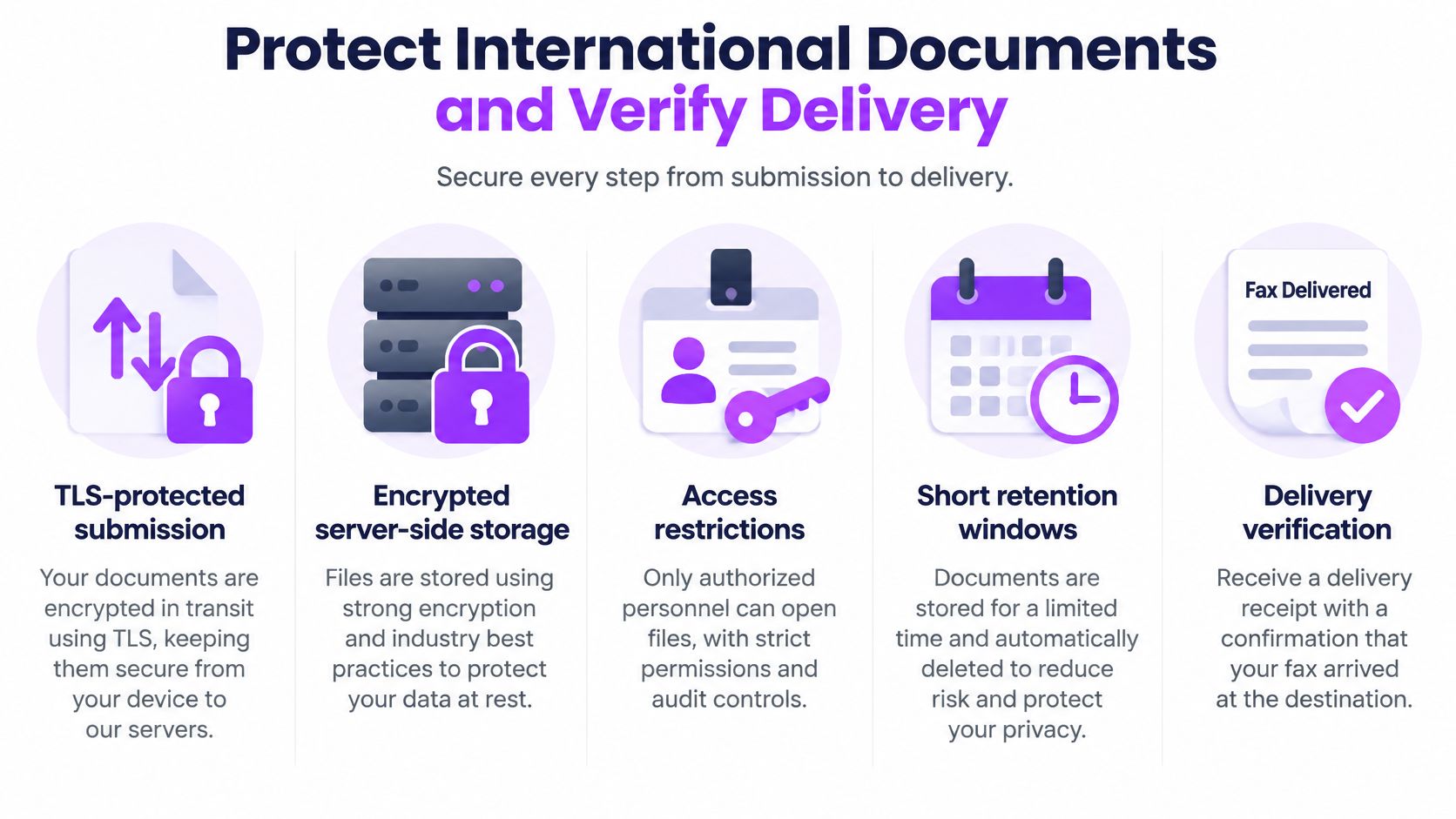
Check for protected submission, controlled access, encrypted storage, limited retention, and an auditable record. FaxZen lists 256-bit SSL encryption, automatic document deletion after 24 hours, Stripe payments, real-time tracking, and email confirmations with the original document attached. A useful fax transmission report should identify the destination number, timestamp and time zone, page count, outcome, and any error information.
Keep the evidence distinct: confidentiality controls protect information in particular stages; transmission records show what happened between systems; neither proves that a person read or acted on the fax.
Handle Jurisdiction and Purpose Compliance
A successful transmission doesn't establish legal sufficiency. Under EU Regulation 2020/1784, electronic service of judicial and extrajudicial documents between Member States is permitted only when that method is available under the forum country's domestic law (EU service regulation). In the United States, the FCC defines international telephone calls as regulated at the point they originate. Since fax uses telephone-network routing, the sender's jurisdiction may matter too.
Before sending a court filing, contract, tax response, or financial document, confirm that the recipient accepts fax for that purpose and that you're authorized to send it. Check the recipient's identity and number, limit the information to what's necessary, use a clear cover sheet, and retain the transmission record. For high-stakes matters, check local requirements with counsel or the relevant authority. A guide to document attestation services across the UAE illustrates why document formalities can vary by jurisdiction. More on the broader considerations is available in regulatory compliance guidance.
Apply International Faxing to Real Workflows
Legal scenario: A law firm sends a signed contract to a recipient abroad. Staff verify the number and preserve the report, then check separately whether fax is an accepted method for the contract or any required legal service.
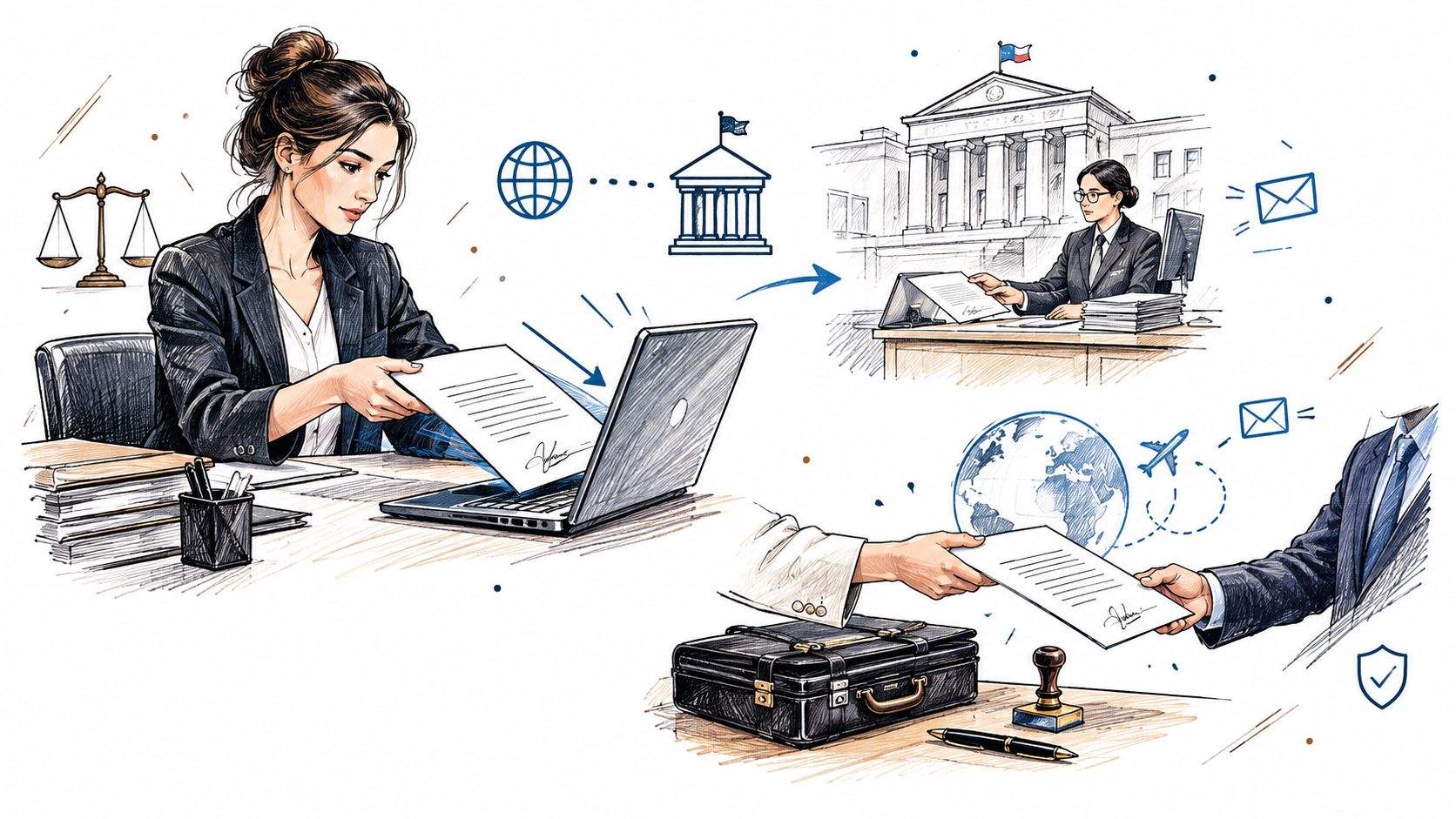
Healthcare scenario: A clinic sends a record or insurance document, confirms the intended recipient, and avoids including unrelated information. Tax scenario: An individual responding to a foreign tax authority verifies the official number, includes concise instructions, and saves the confirmation.
Banking scenario: A customer sending financial records checks the bank's fax instructions and protects the upload. If the destination is in Canada, review international faxing to Canada for destination-specific considerations. In each case, receipt by a fax system is not the same as confirmation that the recipient has processed the document.
Use a Reliable Pre-Send Checklist
Start with the destination country and its country code. The ITU explains that country codes contain one, two, or three digits identifying the destination country (ITU country-code guidance). A locally formatted number may not route internationally, so check the full number and any country-specific dialing rules.
Timing also affects whether a fax is useful. In a 2025 healthcare survey, 88% of practitioners said fax-related delays negatively affected patient care, 52% of teams manually processed incoming faxes, and 44% of faxed documents were time-sensitive (healthcare fax delays). Schedule with local business hours, weekends, and holidays in mind. Add clear cover-page instructions, plan sensible retries, and confirm receipt when stakes are high.
| Verify | Why it matters | Record before sending |
|---|---|---|
| Country and complete fax number | Prevents misrouting | Country, code, recipient number |
| Recipient and fax acceptance | Checks purpose and destination | Name and acceptance confirmation |
| File, sensitivity, and cover sheet | Reduces disclosure and handling errors | Page count and document version |
| Time zone and local calendar | Helps the recipient process it promptly | Intended send window |
| Delivery evidence | Supports follow-up | Status, timestamp, and errors |
Choose a Service and Send With Confidence
A provider is closer to a courier than to a regulator. It can carry the document, show where it was sent, and report whether the receiving fax answered. It cannot make the destination organization accept fax for that purpose, make a local rule treat the copy as sufficient, or guarantee that someone acts before a deadline.
Ask which countries the service supports, how it validates numbers, what the completed price includes, which security and retention controls it documents, and what delivery evidence it supplies. For occasional senders, FaxZen offers PDF or image upload, broad country coverage, round-the-clock support, status tracking and email confirmations, and a basic flow that does not require an account.