A Modern Guide to Secure Electronic Faxing for Professionals
Table of Contents
In an age of instant messaging and email, the fax machine’s staying power in professional settings can seem a little strange. But for transmitting sensitive information, it’s long been a trusted workhorse. For today's organizations, though, that trust has to evolve to meet modern digital security standards. A secure electronic fax service isn't just a nice upgrade anymore; it’s a non-negotiable for protecting critical data and maintaining operational integrity.
Ready To Fax?
Start sending faxes online in seconds with FaxZen - No account required
Send Fax Now 🚀Ready to secure your communications? Start sending faxes securely today with FaxZen.
Why Secure Faxing Is Essential in the Modern Workplace
The reliance on faxing comes from its old-school, point-to-point security. Before digital networks were everywhere, sending a document over a phone line felt direct, private, and contained. But that traditional view completely misses the huge risks we face today—from simple misdials sending sensitive records to the wrong office, to confidential documents left sitting in the open on a physical machine. The stakes are incredibly high. We're not just talking about steep financial penalties for data breaches, but the kind of incident that can permanently shatter client trust.
The global fax services market is far from obsolete. It's actually projected to hit $6.5 billion by 2029. This growth isn't about old hardware; it's about a massive shift from traditional machines to sophisticated online platforms. The demand for secure, regulated solutions is what’s fueling this, proving that electronic faxing will remain a critical tool for industries like healthcare, legal, and finance for years to come. This evolution is a direct response to the need for rock-solid security. While a classic fax machine offers a sense of privacy, it lacks the fundamental safeguards required in today's digital world. Our guide on fax machine security dives much deeper into these specific vulnerabilities.
Key Takeaway: The core problem isn't faxing itself, but how it's managed. Unsecured paper trails, a total lack of encryption, and no verifiable audit logs make old-school fax machines a massive liability. A modern electronic fax system is designed to solve these exact problems.
Failing to protect sensitive data isn't a minor slip-up. The consequences can be devastating, hitting an organization from every angle. Understanding these risks makes it crystal clear why a robust, secure solution isn't optional—it's essential. Switching to a secure electronic faxing solution is one of the smartest proactive moves you can make. It transforms the act of sending sensitive documents from a high-risk gamble into a protected, auditable process. This shift is absolutely vital for any organization that's serious about protecting its clients' most sensitive information.
Decoding Security Safeguards for Digital Faxing
When you're dealing with confidential information, just picking any old digital fax service won't cut it. The service has to be built around a robust framework designed to protect data from every possible angle. Think of it as a multi-layered defense system for your data, built on three core pillars of protection. Each one plays a distinct, critical role. A truly secure electronic fax solution has to nail all three. No gaps, no shortcuts. Understanding what they are is the first step to making a smart choice for your practice.
First up are Technical Safeguards. These are all the technology-focused measures that protect electronic data. Think of this as the digital fortress around your information—the software, network protocols, and security features that control who gets in and what they can do. Encryption is a perfect example. A secure electronic fax service uses powerful encryption to scramble the data, making it completely unreadable to anyone who might try to intercept it while it's in transit. But it goes deeper. Strong access controls are non-negotiable, with things like multi-factor authentication (MFA) being a must-have. This adds a crucial layer of security beyond a simple password.
Next are Administrative Safeguards, which create the rules for how people use the technology. This is the human side of security, focusing on the policies, procedures, and training that minimize the risk of someone making a mistake that leads to a breach. These safeguards ensure everyone in your organization understands their role in protecting sensitive information. It covers things like comprehensive workforce training on security best practices, clear protocols for verifying recipient fax numbers, and a concrete plan for what to do if you even suspect a data breach. For a closer look at these protocols, our guide on online faxing HIPAA compliant practices offers more detail.
Finally, we have Physical Safeguards. This is all about protecting the actual, tangible hardware where data is stored—the servers, the data centers, and even the laptops or phones that can access the information. It’s about securing the physical gear from real-world threats like theft, tampering, or even a fire. For an electronic fax provider, this means their data centers need Fort Knox-level security, including controlled access, 24/7 surveillance, and environmental systems to protect the hardware.
| Safeguard Type | Primary Focus | Key Examples |
|---|---|---|
| Technical | Technology and Data | Encryption, Access Controls, Audit Trails |
| Administrative | People and Policies | Employee Training, Risk Analysis, Vendor Agreements |
| Physical | Hardware and Facilities | Secure Data Centers, Workstation Security |
When you understand how these three safeguards work in concert, you can properly evaluate whether an electronic fax service gives you the layered, comprehensive protection you need.
The Indispensable Role of a Service Agreement
When you sign up with an electronic fax service, you're doing more than just buying software. You're handing over some of your most sensitive data to a third party. This is why a formal Service Agreement, particularly a Business Associate Agreement (BAA) in healthcare, isn't just important—it's the absolute legal bedrock of your partnership. It is the formal, ironclad contract that turns a simple vendor relationship into a secure, compliant one. This document spells out every single one of the vendor's duties, creating a clear and enforceable framework for protecting data.
A vendor’s willingness to sign a BAA is often the clearest signal of their commitment to security. If a provider hesitates or refuses to sign one, it's a massive red flag. A solid agreement is specific and comprehensive, leaving no room for misinterpretation. While the exact wording can differ, every robust BAA should clearly define several key areas to make sure your practice is fully protected. Knowing what to look for is crucial when evaluating a potential faxing partner. This scrutiny should also extend to their own vendors, so be prepared to ask detailed questions regarding Business Associate Agreements with subcontractors to ensure security is maintained down the entire chain. For a deeper look into handling these critical agreements, reviewing some contract management best practices can offer valuable guidance.
Key Features of a Truly Secure Electronic Fax Service
So, what does a genuinely secure electronic fax service actually look like in the real world? It's a critical question because not all digital fax platforms are created equal. You have to look past the marketing claims and verify a few specific, non-negotiable technical features. The absolute cornerstone is powerful, end-to-end encryption. Any modern service handling sensitive information must use 256-bit Advanced Encryption Standard (AES) encryption and Transport Layer Security (TLS). This dual-layer approach ensures data is protected both in transit and at rest.
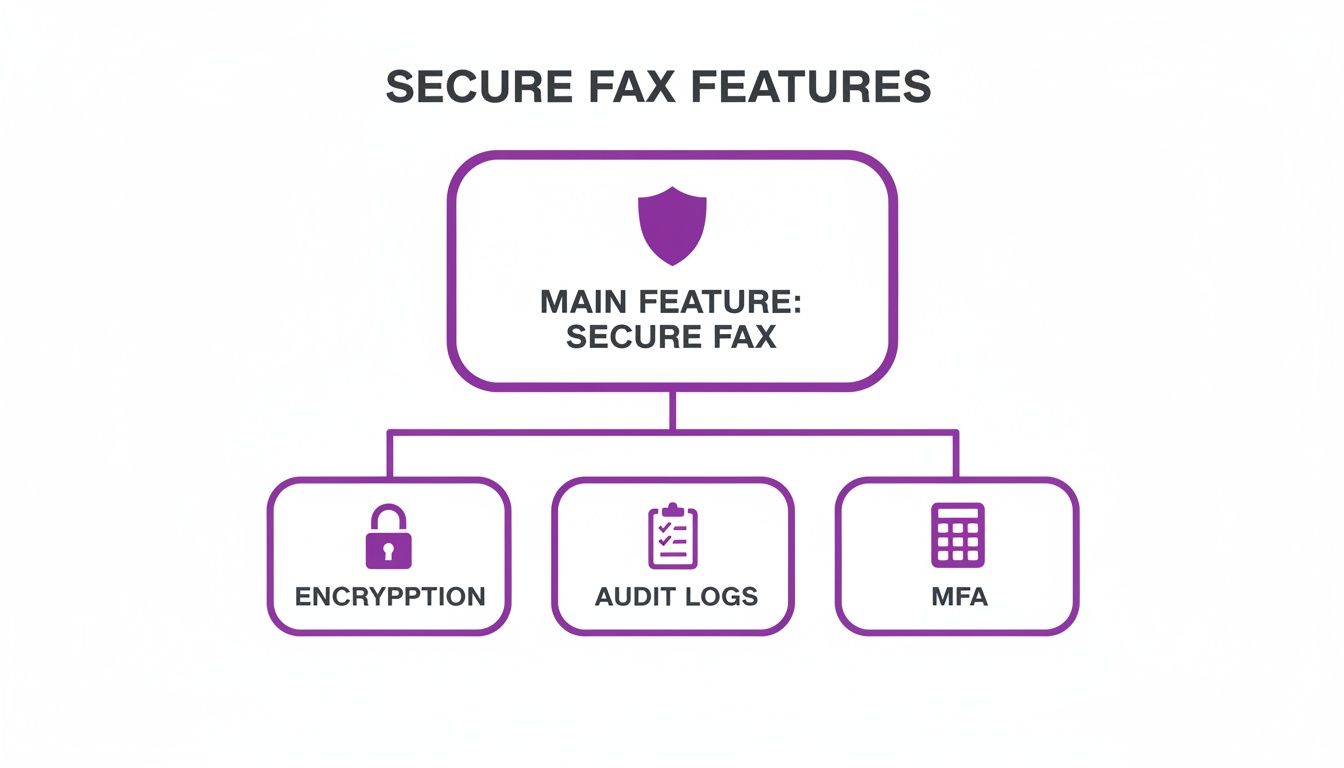
It’s not just about protecting data from outside hackers; it’s also about controlling who can see it on the inside. A top-tier service gives you granular control over who can access, send, and view faxes, starting with multi-factor authentication (MFA). Accountability is just as important as prevention. A truly secure electronic fax service must provide detailed and unchangeable audit logs for every single transaction, capturing who sent what, where it went, when, and who viewed it. This level of tracking is essential for passing compliance audits and for investigating any potential security incidents. For a more detailed breakdown, check out our guide on what defines a HIPAA compliant eFax service.
The table below breaks down some of the key distinctions you'll find between a basic service and a professionally secure one.
| Feature | Standard Online Fax | Professionally Secure Electronic Fax |
|---|---|---|
| Encryption | Basic or optional SSL | Mandatory 256-bit AES (in transit & at rest) |
| User Authentication | Simple password only | Multi-Factor Authentication (MFA) supported |
| Audit Logs | Limited or basic tracking | Comprehensive, immutable audit trails |
| Vendor Agreements | Not typically offered | Willingness to sign a Business Associate Agreement |
In the end, it’s about choosing a service that understands these differences aren't just features—they are fundamental requirements for protecting your organization.
FAQs: Your Questions on Secure Faxing Answered
Here are answers to some of the most common questions about using a secure electronic fax service.
Why is secure electronic faxing better than email for sensitive data?
Standard email is like a postcard; it's sent in plain text and is open to interception. Secure electronic faxing is like an armored truck, using end-to-end encryption to seal the information from sender to recipient, making it unreadable to unauthorized parties.
Can I use any online fax service?
No. Most standard online fax services are built for general business use and lack the critical security features needed for sensitive industries, such as robust encryption, detailed audit trails, or the willingness to sign a Business Associate Agreement (BAA). Using a service not specifically designed for regulated data puts your organization at significant risk.
What happens if a secure fax is sent to the wrong number?
Human error happens. A key feature of a secure service is the detailed audit trail. If a fax is misdirected, you have an immediate, unchangeable digital record of the event. This allows you to immediately enact your incident response plan, notify the incorrect recipient, and meticulously document the mistake for compliance purposes.
Is an online fax service really more secure than a physical fax machine?
Yes, significantly. A physical fax machine leaves a paper trail, lacks encryption, and has no audit logs. Documents can be left on the tray for anyone to see. A secure electronic fax service encrypts the data, requires authentication for access, and creates a detailed log of all activity, providing a far more controlled and secure environment. To get a better sense of how different vendors perform, it's worth checking out an online fax service comparison.
Related Articles
- Online Faxing HIPAA Compliant: The Definitive Guide
- Fax Machine Security: A Guide to Protecting Your Data
- Contract Management Best Practices for Modern Businesses
FaxZen offers a simple, secure, and reliable solution for all your electronic faxing needs. Send your first fax securely today.